Showing posts with label Canadian Fantasy. Show all posts

Saturday, September 30, 2017

Muse and Reverie

Charles de Lint's 2009 short story collection Muse and Reverie appears to be the last visit he planned to his fictional setting of Newford for some time. The stories, originally published in a number of fantasy fiction collections (including one featuring Hellboy!), are a nice mix of stories, shifting back and forth between urban fantasy and dark fantasy, as well as one adorable Christmas story featuring the crow girls.

The first story in the collection was previous included in his Waifs & Strays collection, but otherwise these were all new to me and were a great delight to read. As I've only got six more stories after this until I'm caught up, and it looks like this is the latest short story collection, I have to admit my enjoyment was a little bitter sweet - soon I'll be joining de Lint's other fans, but like them, I'll have to wait to get more stories until he publishes them.

Saturday, September 9, 2017

Book Review: Eyes Like Leaves

Charles de Lint's Eyes Like Leaves was a pretty fascinating read for me, sort of a "what could have been novel". Originally written as his fourth novel, the story falls nicely into the High Fantasy sub-genre (think Lord of the Rings), rather than the Urban Fantasy he's much more connected to these days. The author actually notes in the introduction that the advice he was given by an editor at the time was only to publish if he wanted to focus future works on High, rather than Urban, Fantasy.

The story works quite nicely as a traditional quest-style novel, following a bard, a wizard in training, and a young woman who all seem to be tied together through destiny to the strange creatures who have suddenly begun attacking people throughout the land.

De Lint shines best with characters and setting, and although he does a great job with this novel, I'm a much bigger fan of his urban fantasy stories. A fun read, but really for dedicated fans rather than new readers of the author.

Monday, June 19, 2017

Book Review: Dingo

Charles de Lint's 2008 novella Dingo focuses on two young men who both fall for the same girl, and what they do to try and win her affections.  Of course, being a de Lint story, there ends up being more than a little magic, danger and even a visit to a world separate, but not that different, from our own.

The novel focuses on Miguel, a seventeen-year-old high school student who falls immediately head over heels for the new girl in town, Lainey, an Australian girl with a strange dog.  Things get more confusing when the usually friendly Lainey starts acting like she's never met Miguel and then Johnny, a local bully, seems to take an interest in her as well.

The novel uses Australian folklore and merges it quite nicely with the world de Lint has created in his city of Newford.  None of his regular characters make an appearance in this novella, but as per usual, much of the story focuses on how normal folk deal with a undeniable confrontation with the world of magic.

A fascinating, if short, read.

Tuesday, May 23, 2017

Charles de Lint's Little (Grrl) Lost (2007) is a YA novel focusing on a friendship between two teen girls, T.J. and Elizabeth, the first having recently moved from the farm to the suburbs and the second having just run away from home. Although T.J. is more straight-laced and Elizabeth is a little more punk, the big difference between the two of them comes down to size; while T.J. is a pretty normal young woman, T.J. is a Little, and therefore stands at about six inches tall.

The Littles were first introduced in the collection Tapping the Dream Tree, and although this novel does take place near Newford, it's connection to de Lint's regular cast of characters is pretty limited. A fun jumping on point for new readers and a great story about friendship and finding your place in the world as well.

Sunday, May 7, 2017

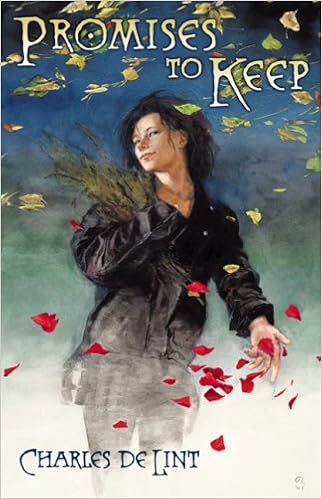
Book Review: Promises to Keep

So after finished Widdershins, wherein de Lint has written a very nice finale for two of his favourite characters, what is the appeal of a prequel novel looking at one of them during her college years? Actually quite a lot.

Promises to Keep follows perennial favourite Jilly Coppercorn in an earlier time in her life, shortly after she came to Newford in the first place, and works as both a great little story in its own right, and also a pretty great jumping-on point for new readers who may not want to go all the way back to The Dreaming Place, written nearly two decades earlier, as well as a story that acknowledges that although very interested in the magical aspects of the world, Jilly spends the first part of the series of books with no direct contact, only hearing about this world through the stories of her friends.

The story is short and sweet, focusing on issues of lost friends and things that may have been and left me feeling quite satisfied and looking forward to reading more.

Saturday, April 8, 2017

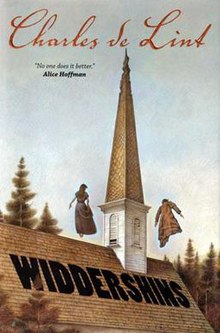
Book Review: Widdershins

One of my favourite things about reading Charles de Lint's Newford stories is how characters will pop up as main characters for a novel or a short story, and then step into the background for the next story; sure there are mainstays like the Riddell brothers or Jilly Coppercorn, but overall you get a different view of the city each time you go back sort of like Terry Pratchett did with Discworld.

Sometimes, however, you do really want to know what happens next, and in the latest of his books I've read, Widdershins, we follow up with Jilly a few years after the events of The Onion Girl and get to see what may be one of my favourite things in these types of stories, a collection of almost all my favourite characters over the twenty-years of stories working together to help a friend in need.

Like Louis L'Amour's The Sackett Brand (1965) or heck, even Kevin Smith's Jay and Silent Bob Strike Back (2001), this book is really for the fans. For the people like me who have been reading about Jilly and Geordie since the short story "Timeskip" back in 1989, this is a really fun reward.

Almost every new story de Lint sets in Newford works as a standalone, but I will say this one works best if you've read the short story collections, The Onion Girl and Spirit in the Wires.

Well worth reading, and as I'm nearing the point where I'm up to the books published ten years ago, I'm already starting to get nervous about when I'll have to wait like every other de Lint fan for his new books to come out.

Sunday, April 2, 2017

Book Review: The Blue Girl

Charles de Lint's 2004 YA novel The Blue Girl, follows two best friends Imogene and Maxine, through a year in Newford's Redding High. Throughout the novel the girls get involved in the world of Faerie (pretty much a requirement in a Newford-based story), and although there are a few familiar faces (Christy Riddell for one), this is mostly a new story with new characters in a familiar setting.

The book rotates between three narratives, Imogene, a new girl in school (and Newford), hoping to have a fresh start, Maxine, a quiet student looking for a friend, and Adrian, the ghost of a boy who died in the school years ago.

What I really liked in the story was just how small it was - there are no massive demi-gods or mystical creatures like in the Jack of Kinrowan books (which I also loved), just two friends trying to make it through the school year and getting caught up in something bigger than they expected. What surprised me the most in the novel was the depiction of Maxine's mother, who beings the novel as an almost cartoon-ish example of the controlling mom, but then changes throughout the story into a fully fleshed-out believable parent.

In the end the book was a lot of fun, and I hope I find these characters popping up in future works by de LInt.

Tuesday, February 7, 2017

Book Review: Spirit in the Wires

Charles de Lint's 2003 novel Spirits in the Wires is one of those delightful fantasy novels that works both on it's own merits and as an interesting look at how we viewed The Internet in the early 2000s. The novel, based in his fictional city of Newford, connects Christy Riddell, a renowned folklorist (and regular Newford supporting character) to two women, Christianna Tree and Saskia Madding, both of whom come from strange beginnings and are about to go on a journey that melds the World Wide Web with de Lint's faerie mythology.

In the novel a virus has struck the Wordwood, a popular website that works like a sort of sentient Wikipedia, and has been mentioned in any number of de Lint's other works over the years. Initially shutting down the website, the virus mutates and soon regular users of the site disappear in a sweeping world-wide event that connects the novel's primary characters with a number of others from de Lint's world.

The story works as a journey, but travels back and forth between three groups, giving the reader a number of well-developed characters to follow and some pretty amazing wonders along the way. I don't want to get into too many specifics as much of the fun of the novel comes from the various twists and turns of the plot, but it is definitely well worth the read.

Sunday, November 20, 2016

Book Review: Tapping the Dream Tree

Charles de Lint's fourth short story collection set in Newford mixes perspectives (a number of the stories are told in first person), characters (both old and new), and ideas - including a ghost story unlike any I've read before "The Witching Hour", as well as stories of Pixie infestation via the internet, sequels to a number of favourite short stories from across his career to date and the addition of the novella Seven Wild Sisters as a bonus.

As always, the stories are a great deal of fun, mixed with terror and pathos, and had me looking forward to my next book from de Lint.

Monday, August 22, 2016

Book Review: The Onion Girl

When reading any series, in any genre, you eventually come across a book that works to put everything you've read together, showing you a perspective on the world you haven't seen before, sometimes this happens quite early (like Stephen King's The Drawing of the Three - book two of his Dark Tower series, or Louis L'Amour's The Sackett Brand - book five of his series focusing on the Sackett family).

For me, Charles de Lint does this in his tenth book focusing on his fiction city of Newford The Onion Girl, which focuses finally and specifically on artist/waitress/fierce woman Jilly Coppercorn, and finally grants her the wish she's had in all of his books, to see the world of magic; of course, seeing the larger world has it's own costs as well...

The book begins with Jilly awakening after a hit-and-run car accident, stuck in a hospital bed and in significant pain, and as she is now the person who needs support, all of her friends (and many of the leads from previous de Lint novels and short stories), rally around her in her time of need. But the accident, which seems to have put a complete stop to her life in Newford, seems to have awoken something else in her, as she now begins to travel in the realm of the spirits while sleeping, letting her see true magic, but also potentially stopping her from focusing on her life in Newford.

As a parallel story, the book introduces Raylene Carter, a woman with a history similar to Jilly's and who took a decidedly different path. Raylene is fun, brash, and more than a little dangerous, and her story was a really nice counterpoint to Jilly's.

The novel does include a previously released short story "In the House of my enemy" (1993), which fits nicely in the narrative and gives necessary backstory to readers new to de Lint's work.

A great book

Tuesday, August 9, 2016

Book Review: Forests of the Heart

Finally moving out of the '90s and into the 2000s, Charles de Lint's Forests of the Heart is a pretty fantastic way to start the new decade.

The novel, set in his fictional Canadian city of Newford, does feature a few of his fan favourite characters, but in this novel they are secondary to a new group, one including artists, musicians, a witch, and some very kind people who get in way over their heads.

As with most of his fiction set in Newford, de Lint focuses on how regular folk interact with the mythic, being creatures or events from beyond our world (but often also from just around the corner), but as with his best work, this focuses largely on his human characters and their all-too-human issues.

Two of the main characters, a used-record store owner named Hunter Cole, and an artist/social worker named Ellie Jones, actually begin with very little in terms of fantasy elements in their lives, neither are the latest in a family lineages of healers (another character in the novel) or have a family history involved with a group of creatures simply called "The Gentry" (that falls to two other characters).  A Big part of what I love about this novel is how well de Lint manages a large cast of characters, deftly switching back and forth between them, without ever losing the inertia of the story.

Forests of the Heart is a well crafted fantasy novel, something I might suggest to bring fans of Urban Fantasy into some of the amazing things the genre of Fantasy can bring to a story.

Thursday, June 30, 2016

Book Review: Moonlight and Vines

Charles de Lint's third collection of short stories set in his fictional city of Newford, includes many reoccurring characters, including favourite Jilly Coppercorn, brothers Christy and Geordie Riddell, and the Crow Girls (featured in Someplace to be Flying). Many of the stories in this third collection focus on death and loss, but de Lint tends to end his stories on a hopeful note.

Standout's for me were "Saskia" and "The Fields beyond the Fields" both featuring Christy Riddell (Newfords analogue of real-world Urban Legend collector Jan Harold Brunvand) and a woman who may be something else entirely.

A fun find for me was "China Doll" a story originally published in an anthology for The Crow franchise, which, although a little at odds with de Lint's Urban Fantasy setting, was still an interesting visit to James O'Barr's original work.

A fun read!

Friday, June 17, 2016

Book Review: Someplace to be Flying by Charles de Lint

Charles de Lint's 1998 novel, Someplace to be Flying begins innocuously enough; a cabdriver witnessing a mugging decides to get involved and ends up getting shot for his troubles. Then, along with the mugging victim (a photojournalist on her way home), he is saved by two young women who appear to be able to fly.

de Lint has always excelled at stories wherein people meet the supernatural and end up shifting their views on the world, but Someplace to be Flying goes much further than this, adding in an entire hidden populace on Earth and drops both characters into the middle of a city wide war. The book actually takes it's time setting up the main events of the story, spending nearly a hundred pages introducing its ensemble and using another fifty for backstory before everything begins to move forward very quickly.

The story is set in Newford, includes a few characters from previous novels and short stories, but is largely populated by new characters, including a set of sisters that are like nothing I've read before (and I've been reading fantasy novels since the mid-eighties), and immerses the reader into an experience including emails, admittance forms and more.

The story works incredibly well at setting up its own mythology and plays fair with all of its charactes (although I have to admit to losing track of exactly who was who twice). A fascinating read and one that already has me looking forward to his next work.

Wednesday, April 13, 2016

Book Review: Memory and Dream

Charles de Lint's Memory & Dream (1994) may be the most ambitious of his books I've read to date. The story takes place in his fictional city of Newford, includes characters he's used in previous works, and focuses on three main characters over the course of twenty years, following them in a non-linear format through college and later as professionals.

Much of the story focuses on Isabelle (Izzy) Copley, an artist who trained under a reclusive celebrity in the fine art world and after a tragic incident spends twenty years living in near isolation until called upon by a friend from help.

Much of the novel focuses on the power of art and the creation process, whether in terms of painting or writing, and uses Isabelle's ability to bring creatures she's painted to life (she calls it "bringing across") as a way to examine the creation process.

Like most of de Lint's novels, there is a fair bit of mythology mixed in with action, adventure and romance, but I was quite surprised to find just how emotionally affecting I found the book.

An excellent read and one that definitely has me looking forward to the next book by this fascinating author.

Monday, December 21, 2015

Book Review: The Wild Wood

Charles De Lint's 1994 novel The Wild Wood, was part of a series called Brian Froud's Faerielands, wherein four different authors based short stories on four paintings presented by Froud.

The version I read was a recent reprint, and did not include the illustrations that appeared in the first edition (which I'm now eager to hunt down), but the novel still stood quite well on it's own.

The book follows Eithnie, a Canadian artist who has been living alone in the northern Ontario woods for a few years after a personal tragedy. After she begins to see strange creatures in the woods, she visits friends in Arizona, and after finding her inner balance returns to her home and the creatures that surround it.

The novel moves on two levels, a mythical one, wherein Eithnie finds she has become part of a strange prophecy, and a very human one, focusing on the healing process after grief.
I was really impressed by the book, and although it was shorter than I had hoped, it was still a great read and left me wanting more.

Monday, August 10, 2015

Book Review: Spiritwalk

A collection of previous released short stories related to characters from his 1984 novel Moonheart: A Romance, Charles de Lint's 1993 book Spiritwalk is pretty fantastic.

Part of what I'm loving working my way through de Lint's fiction is how he ties everything together - this book is not only a sequel, but acknowledges it exists in the same world as both his Jack of Kinrowan character (Jack the Giant Killer, 1987, and Drink Down the Moon, 1990) and his own author character Caitlin Midhir (Yarrow, 1986), and although the shared-world and world-building devices he's used are really fun for readers of his fiction, they aren't even the best part.

What's really great about the stories in Spiritwalk is how he can handle multiple characters through multiple storylines and yet continues to deal with the same themes while never losing their individual voices, from the gruff ex-biker Blue to the mythical Coyote, he creates this amazing world full of characters that breathe and yearn and desire.

Although Spiritwalk may not be for the de Lint first timer (it is a sequel, after all), it was a delight to read and has me quite excited to continue my journey through his stories.

Sunday, July 5, 2015

Book Review: The Little Country

For a while now I've been making my way through the works of Canadian Fantasy author Charles de Lint; finding his books a delight, delighting in his mix of folklore, mythology and fantasy over the course of more than a dozen novels.

Last month I read his 1991 novel The Little Country and it simply blew me away.

Significantly longer than his other books, The Little Country is filled with three distinct storylines, moving from magic realism to high fantasy and interweaving them into something that shows the magic of music and the music in magic.

The novel begins by following Jenny Little, a folk musician from Cornwall who discovers a book in her grandfather's attic by a local author who passed on many years ago, and through her reading of the book, begins to open herself to a strange, and sometimes frightening world of magic.

Seriously, this book is great - I've completely enjoyed my run through his books published throughout the eighties, but if The Little Country is any sort of indication of what I'm going to find in his nineties work, I think I may have found a new favourite fantasy author - and the fact that he, like me, is Canadian, is simply the frosting on the cake.

Read this - it's pretty amazing.

Wednesday, March 25, 2015

Book Review: Drink Down the Moon

Moving through the works of Charles de Lint from the ‘80s to the ‘90s, I’ve found a couple of great reads, but so far nothing has compared to Drink Down the Moon, his sequel to his 1987 novel Jack the Giant Killer.

The book takes place a few years after Jack saved the fae of Ottawa in the first book, and brings a much darker threat to the citizens of Kinrowan (the fairy side of Ottawa), and one with terrible plans for all.

As with many of his previous books, this novel focuses on myth and folklore as well as a lot of music and even a mention of Cat Midhir (the protagonist from his earlier book Yarrow - who I'm hoping to come across again in a future story).

The story is a lot of fun, moving back and forth between Jackie's story and that of a young musician who is just beginning to see the fairy world...

The book was pretty great and has me looking forward to to more of the shared world that De Lint has created in his later works.

Wednesday, October 1, 2014

Book Review: Greenmantle

After reading Jack the Giant Killer (1987) last month and absolutely loving it, I was kind of nervous to see how the next title would measure up. Luckily for me, Greenmantle (1988), is an incredibly effective book which mixes elements of Fantasy and Crime/Thriller together. The story focuses on Freddie Treasure, a woman who has just won the Wintario lottery and relocates to her childhood home with her teenaged daughter Ali. At the same time the story focuses on an ex-Mafia hitman and his attempt to escape his criminal past.

What I love best about this book was how much it made me think of books like American Gods, Fables, and The Unwritten, in that it plays around with how stories work, where they come from, and what they mean. In the case of Greenmantle, the story focuses on the great god Pan, and his various manifestations throughout mythology and the world. Tying this concept into a crime thriller and adding aspects of Fantasy (the story includes a number of classic Fantasy elements), sounds like it should have muddled up the plot, but the book works so well I was at times shocked at how nicely it all fit together. Add into that the fact that Frankie’s daughter listens to John Owczarek (one of the main characters in Mulengro) and reads Caitlin Midhir (the lead in Yarrow), and the book works both as a story in its own right and as a continuation of the amazing world de Lint works to create throughout his fiction.

Thursday, September 11, 2014

Book Review: Jack the Giant Killer

I think I'm just on a roll with my Charles de Lint reading right now.

Last month I read Yarrow and absolutely loved it - the merging of high fantasy (completely new world) and magic realism (wherein magical events happen in our world), was just incredible, and the characters were becoming incredibly strong, three-dimensional people that I would either love to meet, or in the cases of the villain, found intriguing.

…and then I hit Jack the Giant Killer.

This book is absolutely brilliant, it takes concepts from fairy tales and specifically merges them with modern day (well, 1987) Ottawa - which was amazing, and then begins to hint that the Ottawa of Jack the Giant Killer is also the Ottawa of Moonheart - just in a quick reference to a physical location, but still, this is the kind of stuff I get excited about when reading Terry Pratchett or Stephen King.

The novel focuses on a girl named Jackie Rowan, who ends up becoming the "Jack" in a fairy tale, which is both a lot of fun with gender-swapping the traditional role, and bringing forth an incredibly fun character, also Jackie starts doing things that may not work exactly in traditional fairy tales, but make a heck of a lot of sense if strange magic stuff started happening around a real person - like telling her best friend.

This book is great.  I spent almost half the story smiling and the other half really anxious about what was going to happen to this great character.