Showing posts with label David Pringle. Show all posts

Tuesday, January 3, 2017

I just finished a list it took me eight years to complete

Think of some long term goals you've had in life; marriage, wealth, kids, fantasy vacations, retire by 55, you know the type. Those sort of goals that sit just over the horizon waiting for you to catch up, and most of them feeling like there's not much you can do but wait and hope for the best.

Then think of those medium length goals, the sort of five-year-plan goals we have more often that require some work; propose marriage, get a degree, or even pay off your car.

Back in 2008 I had a dose of reality hit me when I heard about David Pringle's Science Fiction: The 100 Best Books Published in English between 1949 and 1984. The book began with George Orwell' s 1984 and ended with William Gibson's Nueromancer. As a huge science fiction fan and a voracious reader, I was fairly certain I would have read at least half of the novels he wrote about. Unfortunately for me; a then 32-year-old Canadian who counted the dozens of Star Trek and movie tie-in novels as a lot, Pringle's UK-focused list left me with a disappointing nine titles in total (four of which I had read as novel studies in Junior and Senior High School).

That left me with ninety-one books between where I thought I would be when I picked up the book, and where I found myself when I put it down.

So, I decided to start with the second book, Earth Abides (which would end up becoming one of my favourite novels period), by George R. Stewart, and try to read a book off of the list each month.

Two weeks ago, nearly eight years after I picked up Pringle's book, I finished John Calvin Bachelor's The Birth of the People's Republic of Antarctica (As a Canadian SF fan, I had read Nueromancer in my teens).

Here's what I learned along the way.

1) As my wife put it to me when I suggested starting a University degree part-time, "you'll be seven years older whether you do the work or not", and she was absolutely right.

2) I've now read my way through a list of books that were pretty good at the worst, and mind-blowing at their best, and honestly, I probably wouldn't have heard of half of these titles had I simply stuck to the SF section of my local bookstore.

3) I found the simple and yet amazing fact that if you take something big, break it down into manageable chunks, and consistently work at it, you can do all sorts of things - even if it takes you the better part of a decade.

BTW - my reward? Knowing that this is the kind of thing I can do with clear goals, consistent work, and a supportive network of friends and family.

What a great way to start a new year!

Thursday, December 22, 2016

Book Review: The Birth of the People's Republic of Antarctica

John Calvin Bachelor's 1983 Science Fiction novel The Birth of the People's Republic of Antarctica is a strange mishmash of old Norse and English sagas, largely focusing on Beowulf and stories of Thor and Odin, with a world on the brink of destruction and the promise of a new society.

The novel follows Grim Fiddle, a Swede destined to become the ruler of a nation at the southernmost pole of the planet and follows him from conception through to old age. Much of the novel takes place at sea, and Bachelor does an interesting thing for science fiction, in that he sets the majority of the novel away from society or in smaller locales where the inhabitants live in a traditional manner, deftly sidestepping both descriptions of futuristic cities, the causes of the the destruction of global civilization and any chance to see our narrator's world through any lens but his own.

The narrative works quite well as saga, following Grim's journey across the years and the globe, moving ever southward and painting a darker and darker picture of the societies he leaves behind, but with little description of the titular republic until the final fifty pages.

An intriguing read.

Sunday, December 11, 2016

Book Review: No Enemy But Time

As I near the end of making my way through David Pringle's Science Fiction: The 100 Best Books, I am increasingly glad for both the new finds and the authors I'm returning to again.

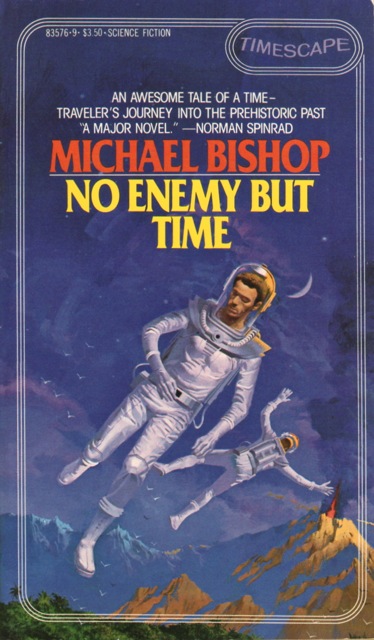
Case in point, last week I read Michael Bishop's 1982 Time Travel novel No Enemy But Time.  This was my third time reading a Bishop novel, but my first time reading his Science Fiction.  Previously I had read the horror novel Who Made Stevie Crye? and the Fantasy novel Brittle Innings and had really enjoyed both.

No Enemy But Time focuses on John Monegal, a chrononaut (Time Travelling explorer) who has been dreaming of the African Pleistocene era since birth, and with the help of an American agency begins the novel by travelling back in time to that specific era.

The novel moves back and forth between his study of the Homo Habilis people he finds in prehistoric Africa and his own life's journey that lead him to this point.

I found the novel fascinating throughout (but was a little confused as to why the cover image (seen above) depicts a white guy when the character is black), and enjoyed both John's journey from boy to man and his later journey with people who only see him as a strange creature.

As a man lost in time novel, it was a heck of a lot of fun, and leaves me interested in both finding more of Bishop's work, and of reading my next (and final) book on this crazy SF list I've been reading for nearly eight years now.

Wednesday, November 2, 2016

Book Review: The Complete Roderick, by John Sladek

With five titles left of my journey through David Pringle's Science Fiction: the 100 Best Books, I've just finished John Sladek's The Complete Roderick, which was originally published as Roderick (1980) and Roderick at Random (1983). The story is highly satirical and follows Roderick, the world's first self-aware robot, as he navigates his way through human culture.

Much of the novel is designed to make fun of the modern world from the point of view of an innocent. Roderick is created in a second-rate university hired by a representative from NASA who is only using the project to cover his own embezzling. As Roderick makes his way through the world (and to be fair, Roderick has no gender, so I should be saying "makes its way") it comes across all sorts of groups and institutions that simply refuse to see it as a robot, and instead assume Roderick is a disabled child. The novel doesn't have a lot of trust for larger institutions and is definitely against capitalism run amok, but at the same time shows how a creature unfamiliar with our world can construct a world view so alien as to seem impossible.

A fascinating read.

Thursday, July 28, 2016

Hitting my first science fiction novel of the 1980s on my list of David Pringle's Science Fiction: The 100 Best Books: An English Language Selection: 1949-1984 feels like a pretty big accomplishment. At this point I've read 94 of the 100 novels listed, and am really looking forward to completing this list.

Timescape (1980), by Gregory Benford follows two separate timelines, one beginning in 1998 and the other in 1962 and both follow scientists (two in an ecological disaster ridden United Kingdom in the later time frame and one a physicist in California in the earlier one). As modern attempts to stop a number of environmental blights have failed, a suggestion is made to send messages back in time using tachyons (faster than light particles) to the earlier time period and avoid the current mess altogether.

What I really enjoyed about this book was how, considering the book could definitely be considered Hard SF (focusing on technical or theoretical detail), an awful lot of the book focused on people and how they reacted to external stresses, all of the scientists families feature, and did a great job of showing just how hard it can be to live with someone so driven by their work.

The novel is pretty great, although not an action adventure like many of my favourite time travel stories, it works its way into your mind, making you ask questions about how time really works and how we perceive our pasts, presents and futures, which is actually a pretty good way to describe any great science fiction story.

Tuesday, February 9, 2016

Book Review: The Walking Shadow

Moving towards the end of the 70's in my reading of David Pringle's Science Fiction: The 100 Best Books, Brian Stableford's The Walking Shadow (1979) takes a look at issues of time travel, futurism, and the question of destiny.

The book focuses on Paul Heisenberg, the author of a book called Science and Metascience and a scientific celebrity who, in front of thousands of people, appears to have been replaced by a perfect silver statue of himself. The statue is actually a sort of placeholder, and over a century later is replaced by Heisenberg again, who hasn't aged a day.

He now finds himself in a dystopian future, one in which many others have discovered how to jump forward in time, and who now view him as a sort of prophet. Upon awakening different factions of the government attempt to bend him to their cause while revolutionaries work to set him free.

The novel follows Heisenberg through his jumps across time and go to places few of us would expect to be waiting in our planet's future. I really don't want to go into specifics as part of the novel's structure works to have him figure out his new surroundings and attempt to find his place in it.

A fascinating read, and not likely to be my last from Stableford.

Monday, November 16, 2015

Book Review: Engine Summer

Nearing the end of the 1970s in my reading of David Pringle's Science Fiction: The 100 Best Books Published in English from 1945 to 1985, I've hit my second book by author John Crowley, Engine Summer.

About a decade ago I read his 1981 fantasy book LIttle, Big, which focuses on a house, which is an entrance to the realm of Faerie, and a family tied to that world as well (it's pretty great).

Engine Summer (1979), takes place ages after us on a significantly depopulated Earth, among tribes (called chords) of peoples living as traders, farmers, hunters and gatherers. Among the people of Little Belaire we meet our hero, Rush That Speaks, a young man who's life changes when he falls in love with a girl called Once A Day, who soon leaves his community to join a group of travelers called Dr. Boots List.

Rush spends the novel travelling, attempting to find his way to either Once A Day, or perhaps to his own Sainthood, examining a world that has long since moved on from it's human populace. Perhaps the greatest strength of the book is it doesn't contain much backstory, requiring the reader to attempt to make sense of the story as they go along, keeping you in the moment with Rush throughout the narrative. The book would definitely benefit from multiple readings as plot points given later change much of what you've read before.

The world in Engine Summer is strange, haunting, and just as you begin to understand any specific setting, moves into stranger situations, still. At the same time, there are moments of humanity in the novel that completely caught me off guard, and truths for Rush that change everything.

Tuesday, April 14, 2015

Book Review: Woman on the Edge of Time

Having now hit the year of my birth (1976) in my copy of David Pringle's Science Fiction: The 100 Best Books published in English from 1945 to 1985, the stories are getting a little different for me; Although some of the concepts and technology still requires me to look them up, I'm getting to the point where I'm sharing the same (or at least a similar) frame of reference with the author and the target audience.

Marge Piercy's Woman on the Edge of Time is a little different from most of the science fiction I've come across, as much of the story can either be viewed as a tale of a telepath or the ravings of a crazy person.

The story, taking place in 1976, follows Consuela (Connie) Ramos, a 37-year-old woman who begins to book by being unjustly sentenced to a mental institution by her niece's boyfriend and also happens to be receiving telepathic transmissions, and visits, from a few hundred years in the future.

The book moves back and forth between Connie's psychic visits to a pretty Utopian future world (it's not perfect, but pretty close) and her attempts to escape or graduate from the institution she finds herself in (which is pretty similar to Ken Kessey's 1962 novel, One Flew Over the Cuckoo's Nest). 

A lot of what I really liked about the novel (which I viewed as actual visits from the future, btw), was how easy it would be to discount Connie's experiences and assume they are a fantastic world she has created for herself, but I found the book to be much more interesting if viewed as actual visits from and to the future.

A Fascinating Read!

Tuesday, December 16, 2014

Book Review: Galaxies, by Barry N. Malzberg

Having worked my way through 80% of David Pringle's Science Fiction: The 100 Best Novels, I've read a lot of different types of SF; from dystopian futures to time travel and space opera, but until yesterday I had never read anything quite like Barry N. Malzberg's 1975 novel, Galaxies.

The book (sorry for the mild 39-year-old spoiler) is stealth metafiction with a strong satirical bent, but you'd never guess this from the cover.  In fact, the cover image, of a spaceship flying into a skull, looks and reads exactly like a standard classic science fiction novel, still smelling faintly of the pulps, and probably published somewhere in the mid to late 1950s.

Once you open the book however, things go sideways very fast.  The novel moves between the writer talking about himself and his life to concepts of main story and back again, with quite a few musings on science fiction as a genre, it's readers and it's writers.

I absolutely loved this book - the story was fast paced, intriguing, and hard to forget, which honestly describes a lot of the fiction I love.

Well worth the read.

Tuesday, January 14, 2014

Book Review: Looking Backward 2000 - 1887

Usually when I'm reading science fiction that involves tire travel to the future, things do not go as well as I would like: alien invasions, catastrophic plagues, or massive natural disasters, so you can imagine how pleased I was to come across this little book (written in 1888) called Looking Backward: 2000 - 1887, by Edward Bellamy, where the future actually looks just fine (considering the "future" in the book is in the year 2000).

I actually came across this book while looking for another book; Mack Reynolds' Looking Back from the year 2000. which is part of my current project to read all 100 books in David Pringle's Science Fiction: The 100 Best Novels.  While looking for the book in various library catalogues, i kept coming across the one from 1887 - which makes sense and the later book is a follow-up to the earlier one.

In the book (the original one), Julian West, a young man from Boston in 1887 is transported to the year 2000, where everything is actually going pretty well.  Yes the book is definitely a description of a socialist utopia, but as a socialist, I'm kind of okay with it, and to be fair, reading the book got me pretty excited to check out the 1974 follow up by Mac Reynolds.

Thursday, April 12, 2012

Things I’ve Noticed: My introduction to ‘70s SF was pretty awesome


So for the last few years I’ve been working my way slowly but surely (and sometimes a little surly) through the book Science Fiction: The 100 best novels an English Language Selection, 1949 and 1984, edited by David Pringle. Right now I’ve read the first 63 in order (from George Orwell’s 1984 (1949) to Poul Anderson’s Tau Zero (1970) and 68 overall. With Tau Zero I have finally left the ‘60s and moved into the Science Fiction of the 1970s, which for me was the decade of some of the more influential SF films (Star Wars) books (Rendezvous with Rama) and television (Mork and Mindy) of my childhood.

Ahead of me I have 24 ‘70s-era science fiction novels, (excluding The Dispossessed by Ursula K. Le Guin, which I read a few years back) and event though I’m not familiar with all of the titles or authors, this list has treated me pretty well so far, giving me a number of books that happily sit in both my top ten list of Science Fiction novels and even one that sits in my top ten favourite books list (Flowers for Algernon).

My first entry into ‘70s science fiction from the list was Poul Anderson’s Tau Zero, which focuses on a colonizing ship (crew of 50) travelling to a nearby star system in an attempt to see if the planet will work as an Earth Colony. The book is great, I don’t want to wreck it with any spoilers – simply find this book and read it.

I know that for my BFF Mike the ‘70s were not his favourite era in SF (he was reading his way through the Hugo Awards), but I’m hopeful that I’m going to be hitting a lot of good stuff.
BTW, if anyone out there has read any of my next five books: Downward to the Erath (Robert Silverberg), The Year of the Quiet Sun (Wilson Tucker), 334 (Thomas M. Disch), The Fifth Head of Ceberus (Gene Wolfe), The Dancers at the End of Time (Michael Moorcock) or Crash (J.G. Ballard) be sure to let me know what you thought.