Showing posts with label
Everyman Library Children's Classics.
Show all posts
Showing posts with label
Everyman Library Children's Classics.
Show all posts
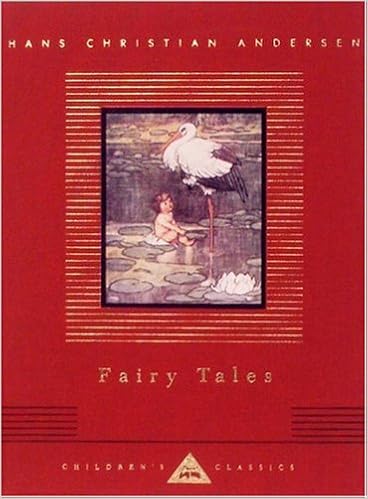
When it comes to series of books, I'm sort of a catch-and-release collector; I like to spend a few years collecting a series, then another year reading it, and then I either sell it in complete form to a used-bookstore or pass it on as a gift to someone who I think would really enjoy it).
For the last few years I've been working on the Everyman's Library Children's Classic Collection, collecting various versions of fables and fairy tales from throughout the world. But as I'm reading a science fiction update of the classic story The Snow Queen later this month, I thought it would be a good idea to check out the original.
Danish author Hans Christian Andersen (1805-1875), most famous in much of the world as the creator of a number of fairy tales, including "The Emperor's New Clothes", "The Little Mermaid", "The Ugly Duckling", and the "Princess and the Pea", often told stories from multiple points of view (often of inanimate objects, and yes, I think it's fair to say his "The Steadfast Tin Soldier" is a literary ancestor of Toy Story), and although they don't all end "happily ever after" they are compelling and entertaining none the less.
The collection I read was at times humorous, heartbreaking, and in the case of a few stories, horrifying "Big Claus and Little Claus" comes immediately to mind as it focuses on one man tricking another into destroying his own livestock, murdering his grandmother, and committing suicide - for laughs!?!
Although I wasn't familiar with all of the stories, I found them to be quite readable, and am definitely looking forward to enjoying more of this collection when time allows.
Since February I've been finishing off each reading month with a classic of Western Literatures. My goal is to simply get a better understanding of where our culture comes from and that's about it. I don't have a degree in English, English Lit, or Classics (My degree is in Communications Studies (TV, Movies, Radio, Internet, etc.)) so you'll have to forgive me if I'm making connections which seem incredibly obvious to you.
So far I've read Homer's Iliad and Odyssey and found both to be interesting (if difficult) reads. As a guy I enjoyed the constant blood and guts slaughter going on in the Iliad(seriously, a guy gets hit hard enough his "eyes fell into the dust at his feet" - and who says that horror is a new genre) as well as the many fantastic elements in the Odyssey (Sirens, Cyclops, Magical Imprisonment, etc.)
The list I'm working through can be found in Mortimer J. Adler's How to Read a Book (One of my all-time favourite books, btw), but I have made some additions.
This month for example, accruing to the original list, should be the Old Testament, but I thought that before I dive into it again (this will be my second time), I should start with Aesop.
I think that like all people I have a passing familiarity with Aesop's Fables, going in I remembered there was something about a Lion with a thorn in its paw and something about a crane and a fox being jerks to each other. What I didn't realize was this selection of fables is actually where all sorts of modern animal-based sayings come from. The city mouse and the country mouse was one of his, as was The boy who cried wolf. It's from Aesop we get the saying, "Look before you leap" as well.
The edition I read was an Everyman Library Children's Classic edition, which is a 17th century translation by Roger L'Estrange. Unlike the majority of the other classics of Western Lit I've been buying (currently through the Penguin Classics Imprint) I purchased this one through Everyman because the book looked so good - hardcover, nice feel, and was less than $20.
It was strange that every fable had an obvious Christianity-based reflection at the end (seeing as Aesop supposedly lived around 700 BCE, which puts his fables and morals well into Ancient Greek, rather than Christian morality - some of the stretches of logic to turn the understanding of his stories into a later belief structure seemed a little off to me.
Overall I'm quite glad I checked the book out, it was a lot of fun, pretty fast and continually gave me moments of "That was Aesop? Holy cats!" The Edition I got also includes a significant essay on the life of Aesop (which although not based on a lot of historical detail) was a very intriguing read.


