Thursday, April 6, 2017

Book Review: Unnatural Creatures

Neil Gaiman's 2013 short story collection Unnatural Creatures takes a number of stories written about mythical creatures over the course of a little more than a hundred years, introducing readers to some really great stories and authors.

As with most short story collections, not all are perfect hits, but there are some really great standouts, Samuel R Delany's Prismatica and Larry Niven's Get a Horse, were both a lot of fun, and the final story, Come Lady Death by Peter S. Beagle was simply wonderful.

A great starter collection for people unfamiliar with the fantasy genre, Unnatural Creatures does a great job of showing some of the heights to which the genre can reach.

Monday, April 3, 2017

Book Review: Foundation and Empire

Isaac Asimov's Foundation and Empire, his 1952 follow-up to Foundation, continues where the last story left off; about three hundred years into a (hopefully) 1000 year Dark Age after the fall of a Galactic empire and before the rise of the next Empire. The series focuses on a science called psychohistory, which suggests that with careful tending, this Dark Age can be a mere millennium, rather than the thirty-thousand years it would otherwise take for galactic civilization to rise again.

The second novel focuses on two key events in the rise of the foundation: first, in The General, the last attempt of the crumbling Empire's military arm attempts to destroy the young Foundation before it can gain more power, and; second, in The Mule, a mutant is born with the ability to control those around him, throwing the original psychohistoric plans entirely out the door.

As with the first novel, the stories are short, but the ideas are huge. This was a fast and fascinating read that had me waiting on tender hooks to read the final book in the original series, Second Foundation, as soon as I could.

Sunday, April 2, 2017

Book Review: The Blue Girl

Charles de Lint's 2004 YA novel The Blue Girl, follows two best friends Imogene and Maxine, through a year in Newford's Redding High. Throughout the novel the girls get involved in the world of Faerie (pretty much a requirement in a Newford-based story), and although there are a few familiar faces (Christy Riddell for one), this is mostly a new story with new characters in a familiar setting.

The book rotates between three narratives, Imogene, a new girl in school (and Newford), hoping to have a fresh start, Maxine, a quiet student looking for a friend, and Adrian, the ghost of a boy who died in the school years ago.

What I really liked in the story was just how small it was - there are no massive demi-gods or mystical creatures like in the Jack of Kinrowan books (which I also loved), just two friends trying to make it through the school year and getting caught up in something bigger than they expected. What surprised me the most in the novel was the depiction of Maxine's mother, who beings the novel as an almost cartoon-ish example of the controlling mom, but then changes throughout the story into a fully fleshed-out believable parent.

In the end the book was a lot of fun, and I hope I find these characters popping up in future works by de LInt.

Saturday, April 1, 2017

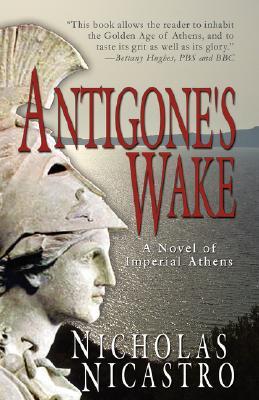
Book Review: Antigone's Wake

Continuing on my journey through Ancient Greece via historical novels, I've now moved passed the Persian War into the beginning of The Peloponnesian War (431–404 BC). This is the whole Athens versus Sparta war that lead to the rise of the Athenian Empire.

This month's book was Nicholas Nicastro's 2007 novel Antigone's Wake, which focused on the character of Sophocles (playwright of Antigone, Oedipus Rex, Electra, etc.), and his career in his early fifties as a military general for Athens.

The novel is short, to the point, and does a great job of painting its protagonist as a man in transition. Sophocles friend Pericles suggests that as Sophocles already knows how to effectively mount a stage play, why couldn't he use his skills towards military victory, and honestly, it would be a largely ceremonial role in response to his recent success with the play Antigone.

The story works quite nicely in painting Sophocles as a man near the top of his game thrust into a position he never trained for or wanted, and how he deals with some terrifying challenges, including his own teenage son coming along for an "adventure".

Considering that history largely focuses on Sophocles role as playwright, an examination of him as military leader was a real treat for me, and one that has me looking to view some of his plays before moving onto my read for next month, which in the end, is the mark of any successful historical fiction novel.

Friday, March 31, 2017

Book Review: Magic

Years ago I picked up the novel Magic by William Goldman for two simple reasons: 1) I'm a big fan of his films (Butch Cassidy & the Sundance Kid, All the President's Men, The Princess Bride, Marathon Man, etc.), and 2) I can never say no to a well received horror or thriller novel.

The story follows a young magician named Corky Withers who just can't seem to catch a break (Hey! I just got the pun on his name :) ) He's a technical pro at card-based illusion, but for some reason his audience presence is just no good; his patter isn't up to snuff, and his discomfort at the showmanship aspect of magic shines through much brighter than his skill set.

Just as he's about to give it up, he figures out a pretty creative new angle, and things start to look up for him.

Or do they?

First of all, what I really like about the book is how well it plays with expectations; everything from the narrative voice to the the shifting of time from past to present and future, really work as analogue for how a well-done card trick works. Just as you begin to piece together what's going on, the story shifts and you realize the author has just been distracting you.

A really fun read, and as I have never seen it, an excellent excuse to someday check out the 1978 film adaption starring Anthony Hopkins and Ann-Margret.

Tuesday, March 28, 2017

Movie Review: Kong Skull Island

So last week I went out with the family to see Jordan Charles Vogt-Roberts Kong: Skull Island, which turned out to be a pretty great decision. As with any giant-sized monster movie, the film really benefits from being seen on a big screen. Past that, it was funnier, scarier, and much more interesting that I first imagined.

Taking place in 1973, the film follows a team of scientists, soldiers, a tracker, and a journalist, as they explore Skull Island, a previously undiscovered island for a simple geological survey, but things are not as they seem and the team quickly (and horrifyingly) meet Kong for the first time...

It's important to note for this film that the violence is pretty extreme (not to a horror-movie level, but definitely more intense than a standard action-adventure film), and that Kong himself (modelled largely after the original 1933 film) is pretty awe-inspiring in size and scope.

This film is meant to the first in Universals "Monsterverse", which will eventually include popular Japanese monsters such as Godzilla, Mothra and Rodan, but works as a nice stand-alone film using a historical setting to give the film an interesting aesthetic as well as great standout performances by Samuel L. Jackson and John C. Reilly as well.

In the end the movie was a lot of fun, and considering it wasn't a horror film, a nice way to do a reimagining as well.

Thursday, March 23, 2017

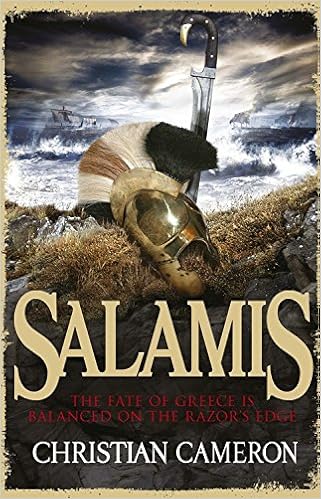
Book Review: Salamis

Christian Cameron's Salamis, the fifth in his Long War series (as well as the next-to-last) follows Arimnestos of Plataea through the battle of Salamis, directly following the events of The Great King, which ended with the defeat of the 300 Spartans at Thermopylae.

What I really enjoyed about this entry was how well it tied together naval battles in the Ancient world with domestic scenes and the life at a war camp as seen through our protagonist. As has been the case since Killer of Men, I'm really in awe of how well Cameron portrays the war seen from the infantry level, and as someone who has been reading books set in the Ancient world for over a year now, this series really stands out as a pretty great entry point for new readers - the only books I'd put ahead of it are Mary Renault's books on Theseus (The King Must Die and The Bull From the Sea).

A really enjoyable read and one that left me caught up with long-time readers of the series, waiting for my turn in the hold queue for the last in the series, Rage of Ares.