Last month I read Gillian Bradshaw's The Sun's Bride, a novel of Rhodes in Ancient Greece and the final book in a 36-book list I'd been reading my way through for the last three years.
First of all, a big thanks to David Maclaine, for both putting together a really great list of historical novels set in Ancient Greece which cover both the Hellenic and Hellenistic periods. Secondly, a big thanks to Mr. Maclaine for following up that list with a 50-book list of historical novels covering Ancient Rome - the reading of which is my reward for finishing the first batch.
Although written before The Sand Reconner, Bradshaw's The Sun's Bride was a great way to finish off this series of books - it follows a young man named Isokrates and digs really deep into the subject of pirates in the ancient world and Rhodes business as pirate hunters. The novel has a lot of action and adventure, as well as a really great female lead in Dionysia, a character who starts out as a damsel in distress but then becomes much more interesting as the story progresses.
A really great read and if you are interested in visiting Ancient Greece through historical fiction, I can certainly vouch for the list as well.

The next-to-last book on my survey of Ancient Greece through historical fiction was Gillian Bradshaw's The Sand Reckoner (2000). The novel tells the story of Archimedes of Syracuse, the inventor most famous these days for the whole water displacement discovery (Eureka!).
The book begins with a young Archimedes returning home from Alexandria to Syracuse which is in a war with Rome. A mathematical genius, Archimedes hopes to find work as an engineer for the city and perhaps help out his family, and very quickly his value to the city becomes apparent to its current tyrant, Hiero, a surprisingly positive example of the type of leader we classify as a tyrant today.
The story parallels it's main narrative with that of Marcus, Archimedes personal slave, and for me, the much more engaging character in the story. Archimedes is interesting, but so in-his-own-head, it can sometimes be frustrating to watch him. Marcus, on the other hand, is much more aware of the world around him, both in terms of the city itself and the larger world.
I had never read Gillian Bradsahw before and honestly just loved this book, it reminded me a little of L. Sprague de Camp's The Arrows of Hercules (1965), but I found it much more engaging.
I'm really looking forward to next month when i complete my list and get to do it with another of Bradshaw's books!

Continuing to work my way through a list of Ancient Greece in 36 Historical novels, I hit #32, Christian Cameron's 2010 novel Tyrant: Funeral Games. This was actually the first time in the entire list where I was being asked to read volume three in a series, so of course I quickly read one and two.
Tyrant Mini-Review
This 2008 novel follows a Greek mercenary called Kinneas and his interactions with the Scythian people during the reign of Alexander the Great. The book was a lot of fun, showing a little known corner of the era.
Tyrant: Storm of Arrows Mini-Review
This 2009 novel follows Greek mercenary Kinneas and his battle with a Macedonian army led by one Alexander the Great's generals. A lot of action, as well as an interesting look at Alexander himself in the latter days of his reign.
Ok, so back to Funeral Games. The novel follows the children of the leads from the first two books as they navigate the collapsing Macedonian Empire after Alexander's death. Twins Satyrus and Melitta begin the novel around age twelve and allow the reader to examine how nobles from different cultures viewed gender, roles, and responsibilities against a backdrop of action, intrigue, and adventure. I think it's fair to say that this list very nicely led me to two great authors, Mary Renault and Christian Cameron.

My fifth book by Steven Pressfield, and his fifth on the list, The Afghan Campaign (2006) takes a look at a specific era in the Macedonian King's conquest of empire during 330 BCE when he attempted to subdue the Afghan kingdoms (modern day Afghanistan). The novel focuses on a recent recruit called Matthias who begins the book by running away from home to join the military, where both his older brothers have enlisted.
Following Matthias on his journey the book begins to feel like a young man coming of age story, then a love story, and then a meditation on the costs of war. Much of the novel focuses on cultural differences between the Macedonian army and those it battles, and Matthias makes a number of clear missteps throughout the book from a place of good intentions but almost total ignorance of the people he is either liberating or conquering, depending on your point of view.
When I tell people I've spent the last few years working my way through this specific list, I'm often asked what draws me to these stories of Ancient Greece, and with certain novels, like John Gardiner's The Wreckage of Agathon or this title by Pressfield, I find the answer is that much of the issues dealt with at that time are still very close to us here are the beginning of the 21st century.
A fascinating read.

As I continue to work my way through this list of 36 Historical novels covering Ancient Greece, two names always bring a smile to my face as they reoccur, Mary Renault and Steven Pressfield. Renault's work gives such an interesting look at aspects of the Ancient world I'm not as familiar with, such as the lives of actors, poets, and even occasionally, kings. Pressfield, on the other hand, wows me both with spectacle and how he pairs ancient philosophies with the events he describes.
His 2004 novel, The Virtues of War begins with Alexander the Great nearing the end of his conquest in India, and looks back across his life at many of the key battles he fought. Pressfield works hard to show Alexander's military genius and after reading Scott Oden's Memnon, I found myself approaching the battles between Alexander and the Persian general with trepidation; I knew how everything would turn out, but had previously only seen it from the other side.
The novel was a really great look at Alexander's world from his own point of view, and although perhaps not as lyrical as Renault treated the same source material, a really excellent read.
Scott Oden's Memnon examines the era of Alexander the Great, but from an outsider's point of view. Memnon of Rhodes was the commander of a group of Greek mercenaries who served the Persian King and is largely thought to have been the empire's best chance against Alexander the Great increasing power as he grew from controlling Macedonia to all of Greece and eventually most of the Ancient World.
The story follows Memnon as a young man in Rhodes, desperate to see his fortune in war, through his own rise to power under his brother Mentor and eventually as the last, best hope of the Persian Empire in the face of Alexander.
I've always been a fan of familiar stories being told from a different point of view and Memnon did not disappoint. Although I wish the book had been a little shorter, the structure was well done and Alexander takes on a very different look when he's eyeing your land as his next conquest.
A really interesting read.

Thomas Sundell's A Bloodline of Kings follows Phillip II of Macedon, father of Alexander the Great from birth through his famous son's birth. An interesting side note, the very first thing you see when you open the book is an inverted map of Ancient Greece with Macedon at the top and the islands at the bottom. This is done "...to illustrate the point of view of the Makedones. Their world centers on the Aegean Sea and the strongest cultural influence is from the heartlands of the Hellenes". Part of what I loved about this is the fact that most of us are very aware, at least in a broad sense, of the story of Alexander the Great, but this is coming from a different perspective, and even the maps in the end pages prepare you for this.
Phillip (spelled Phillipos throughout the novel), is shown from birth through his childhood as an incredibly smart young man raised as support for the rightful king of Macedonia. The fourth child in his family, Phillip seems destined to be forever used as a pawn in his older siblings plans for rule. In many ways similar to Robert Grave's I, Claudius, the royal family of Macedon is seen as filled with potential conspirators, rulers, spies and others all bent on the crown, and it is only through Phillip's ability to navigate his world that he ends up in a position to rule.
The novel is told in present tense and switches often from character to character (including all of Phillip's siblings, wives, and many other friends and foes). Considering he is often viewed as the precursor to the greatness of his son, it is fascinating to see the story of just how fractured Macedonia was when he came into power and the shape he moved it into before the birth of his son.
A fascinating read, and one I hope someday will be followed by a sequel.

M.N.J. Butler's 1995 novel The Fox was almost the one that killed my current streak of one historical novel set in Ancient Greece that I've been doing for the last two years. Following the list found here, I've been slowly but surly working my way from the mythic age, through the Trojan War, Persian War, Peloponnesian war and am now just getting into the age of Alexander the Great.
The Fox follows a spartan soldier called Leotychides who was raised as royalty, through his entire Spartan upbringing, and cleverly sets it against the fall of the Spartan Empire. Similar in many ways to John Gardiner's The Wreckage of Agathon (1970), which is itself set in the beginning of the Golden Age of Sparta and narrated by a philosopher asking where it all went wrong, The Fox shows how a society built on one principle, an elite warrior class who ignore everything else, could not easily stand against the Athenians over any length of time once a shared enemy no longer existed.
The novel was a really fun dip into an area of history I'm becoming quite fond of, and thanks to the power of Inter-Library Loans (wherein one library borrows a book from another) I was able to read this long out-of-print book and continue on with a winning streak that will take me through Alexander the Great's life next year and the fallout after his demise (sorry for the 2300-year spoiler)
A great read!
Mary Renault's The Mask of Apollo focuses on Nikeratos, an actor of some repute living in Syracuse in the aftermath of the reign of the tyrant Dionysius.
The book does a remarkable job of following a society in which a young man (Dionysius II) has been placed in control entirely in conflict with the fact that he is not a leader, doesn't care for his people and wishes to spend all his time at his hobbies.
The novel focuses largely on the lives of actors in the era and seeing the story of a young man's professional career against the backdrop of great change in the world (Alexander the Great's father Phillip of Macedon makes an appearance in the framing chapters of the story).
A remarkable read and one that has me looking forward to the remaining three Renault novel's I'll be reading next year as I finish my read through this list.
Although I have spent the last month switching from game to game in the Five Nights at Freddy's series, in my off time I've been enjoying a number of books from all sorts of genres, including todays little voyage to Ancient Greece in L. Sprague de Camp's 1965 novel The Arrows of Hercules.
The novel focuses on an engineer named Zopyros who creates early siege weapons for Dionysius of Syracuse. The story is full of all sorts of derring do, and from my own experience in fantasy fiction felt an awful lot like a Dungeons & Dragons campaign, including the four random fellows of different backgrounds and temperaments who decide to team up for no reason and seek their fortunes.
A lot of the fun of the novel for me was in the way that de Camp relates Zopyros's work to our modern tech-focused world - wherein he has been hired by someone to do a job no one has ever done before and instead of simply spending his time working on his concepts, he ends up spending an awful lot of it dealing with professional rivals and coworkers hellbent on undermining his efforts.
The novel was a lot of fun and following Manfredi's Tyrant, which focused on Dionysius himself, this was a great way to get a man-on-the-ground feel for how one city state dealt with the aftermath of the Peloponnesian war.

The act of reading the final volume in any series is always a little bittersweet for me; I know I can go back and reread any of the books at my own pace, but this will be the last time I get to visit with these characters for the first time. As I've been working my way through a list of historic fiction set in Ancient Greece, I've since passed the Persian and the Peloponnesian Wars and am nearly onto books focusing on Alexander the Great. While working my way through the main list however, I've been able to return again and again to the life of Arimnestos in Christian Cameron's Long War series, returning to the Persian War for another look at just how a war lasting so long affects any group of people.
Rage of Ares takes the battlefield right back to Arimnestos' homeland Plataea, for the final battles of the war and does a really great job wrapping everything up. I'm still not a fan of the Glossary appearing at the front of the book, but the author's notes, and in this specific case, a technical look at the battle by a historian, added a number of really interesting details to the series which began back in Killer of Men.
Well worth the read and yes, I'll probably revisit the series again, but next up for me will be Cameron's books focusing on Alexander the Great.
Valerio Massimo Manfredi's Tyrant (2005) moves away from mainland Greece and into the Greek colonies in Sicily. Following the life of Dionysius I of Syracuse the novel follows both the rise and fall of the character, as told from the point of view of journals and private papers he left for his son.
The novel follows Dionysis through his early frustrations as poor leadership causes a number of Sicilian cities to be destroyed by Carthage, and then follows his own rise to power, which starts, as is all too often the case, with the best of intentions, but ends in pure corruption.
A really interesting, readable novel, that showcases a part of the ancient world I was less familiar with.
Well worth a look!

So here's an interesting treat; Michael Curtis Ford's The Ten Thousand takes a look at one of my favourite films of the '70s, (Walter Hill's The Warriors (1979)) and tells the story that inspired the novel that the film was adapted from. This is the story of Xenophon's The Ten Thousand.
Taking place in the chaos following the Peloponnesian War and beginning in 401 BC, the novel follows Xenophon and is narrated by his servant and companion Themostigenes (nicknamed Theo), as they join an army of Greek soldiers who decide to fight as mercenaries under Cyrus the Younger in Persia, only to discover the point of their work was a lie and that they have been hired to help Cyrus kill his older brother. Things do not work out well and ten thousand Greek mercenaries quickly find themselves deep behind enemy lines with no support, little food, and most of their leaders betrayed and killed.
The novel follows the story of how (sorry for the 2500+-year-spoiler) this group made their way home. The novel begins as a war story and quickly turns into a story of survival over overwhelming obstacles. The action was fast, the story epic and I was quite happy to have purchased, rather than borrowed my own copy.
In the end, an excellent read, and an even more excellent reason to check out The Warriors again soon.
As I'm working my way through this list of 36 Historical Novels set in Ancient Greece, there are a few authors I'm always happy to get to, Christian Cameron and Steven Pressfield novels both make for excellent reads, but so far my clear favourites are the novels of Mary Renault.
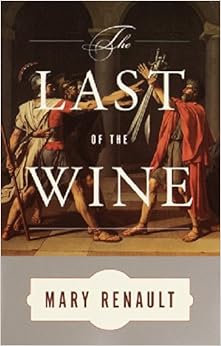
Renault (1905-1983) wrote a number of both contemporary and historical fiction novels, but is most well-known for her works set in Ancient Greece. At this point I've read The King Must Die, The Bull From the Sea, and The Praise Singer, so I was definitely looking forward to The Last of the Wine. The novel takes place during the Peloponnesian War and follows a young man called Alexias, who is famed for both his beauty and his running.
Unlike most of the novels I've read off of the list (17 others to date), The Last of the Wine is largely focused on the lives of the Athenians in Athens. The novel focuses on Alexias teenaged and adult years and portrays the lives of young Athenian men almost as wealthy socialites. Renault does not shy away from homosexuality in the setting, indeed Alexias' father recommends he takes an older lover, and the love of Alexias's life is a man called Lysis. Both men are disciples of Socrates (who figures large in the story) and much of story involves how Alexias deals with his love for his friend over their lives.
A fascinating read and a picture of Athenian life that is too often shown in historical fiction as entirely focused on warfare.
 Nicolas Nicastro's 2005 novel The Isle of Stone takes a look at Spartan Society nearly sixty years after the battle of Thermopylae, specifically during the battle of Sphacteria (325 BCE). The novel focuses on two Spartan warriors, Antalcidas and Epitadas, brothers who were raised in two very different, but traditional Spartan styes.
Much like John Gardiner's The Wreckage of Agathon, The Isle of Stone looks at the Spartan Empire with a jaundiced eye. The empire is portrayed as brutal, and neither brother is drawn in a particularly heroic way. What I really liked about the novel was the character of the warrior's mother and her rationalization for why she helps one brother and hurts the other. The ethics of the Spartans, as described by Nicastro, definitely leave a lot to be desired.
The majority of the action of the story takes place with an army of Spartans under siege on a barren island surrounded by the Athenian navy. The story moves quickly and although I didn't like it as much as Nicastro's other work on the list (Antigone's Wake - which I LOVED!), it does work to give an unflinching look at a culture often celebrated in our modern day.

So I've had a copy of Marie Phillips Gods Behaving Badly in my home for about five years now; both my wife and oldest daughter have read the book, and my wife had said she thought I would really enjoy it, so when I found a copy at a used bookstore I snatched it at once.
First things first - my wife was absolutely right, this is a delightful read and one I should have gotten around to long before this.
The novel follows the major gods of the Classical Greek Pantheon (Zeus, Apollo, Artemis, Aphrodite, Ares, etc.) in the modern world, where they share a small house in London, England. While trying to keep a relatively low profile, they end up affecting the lives of a number of mortals and the end of the world may occur unless a hero can rise to save them all.
A big part of what I like about the book is the soap opera-esque family dynamic shown between the various gods with plots, friendships, affairs and even wars occurring regularly. Yes, a lot of this type of concept has been covered elsewhere (American Gods, Greenmantle and Fables all touch on similar concepts), but Gods Behaving Badly has a nice sense of humour throughout and a reminder of how much more interesting fallible gods can be to a narrative.

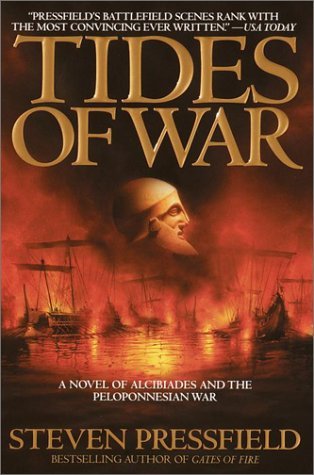
My third novel by Steven Pressfield on this tour of Ancient Greece through Historical Fiction, Tides of War takes place well after the events of The Last Amazon and Gates of Fire, but as with those previous novels, gets deep into the world of Ancient Greece and gives the reader a rare taste of the values and thoughts in world.
Taking place during the Peloponnesian War, Tides of War follows Alcibiades, the nephew of Pericles and one of the greatest generals of the Ancient World. The story is told through two layers; our narrator is interviewing the man responsible for Alcibiades death, who in turn is narrating his life alongside the general over this many campaigns.
What I found most interesting about the story was how little I knew about the general going in; when I've read previous works about Theseus or Sappho or Leonidas, I was at least a little familiar with their lives (Minotaur, Poetress, Spartan King), so when I started reading about a general who switched sides from Athenian to Spartan and even to Persian, I was quite surprised by just how unfamiliar I was with the historical figure. It did lead me to more than a couple quick stops at wikipedia to get a better grasp on the character, but as these books often do, I found it was well worth the distraction.
An intriguing introduction to the Peloponnesian War, and one that leaves me looking forward to the next book off of the list, Isle of Stone by Nicholas Nicastro, with more than a little excitement.

Continuing on my journey through Ancient Greece via historical novels, I've now moved passed the Persian War into the beginning of The Peloponnesian War (431–404 BC). This is the whole Athens versus Sparta war that lead to the rise of the Athenian Empire.
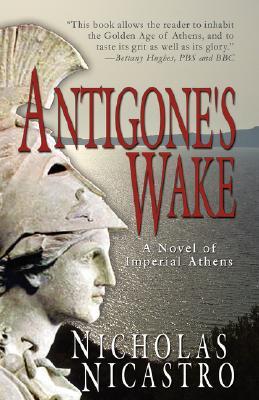
This month's book was Nicholas Nicastro's 2007 novel Antigone's Wake, which focused on the character of Sophocles (playwright of Antigone, Oedipus Rex, Electra, etc.), and his career in his early fifties as a military general for Athens.
The novel is short, to the point, and does a great job of painting its protagonist as a man in transition. Sophocles friend Pericles suggests that as Sophocles already knows how to effectively mount a stage play, why couldn't he use his skills towards military victory, and honestly, it would be a largely ceremonial role in response to his recent success with the play Antigone.
The story works quite nicely in painting Sophocles as a man near the top of his game thrust into a position he never trained for or wanted, and how he deals with some terrifying challenges, including his own teenage son coming along for an "adventure".
Considering that history largely focuses on Sophocles role as playwright, an examination of him as military leader was a real treat for me, and one that has me looking to view some of his plays before moving onto my read for next month, which in the end, is the mark of any successful historical fiction novel.
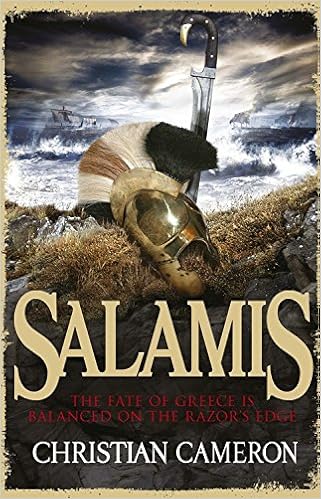
Christian Cameron's Salamis, the fifth in his Long War series (as well as the next-to-last) follows Arimnestos of Plataea through the battle of Salamis, directly following the events of The Great King, which ended with the defeat of the 300 Spartans at Thermopylae.
What I really enjoyed about this entry was how well it tied together naval battles in the Ancient world with domestic scenes and the life at a war camp as seen through our protagonist. As has been the case since Killer of Men, I'm really in awe of how well Cameron portrays the war seen from the infantry level, and as someone who has been reading books set in the Ancient world for over a year now, this series really stands out as a pretty great entry point for new readers - the only books I'd put ahead of it are Mary Renault's books on Theseus (The King Must Die and The Bull From the Sea).
A really enjoyable read and one that left me caught up with long-time readers of the series, waiting for my turn in the hold queue for the last in the series, Rage of Ares.
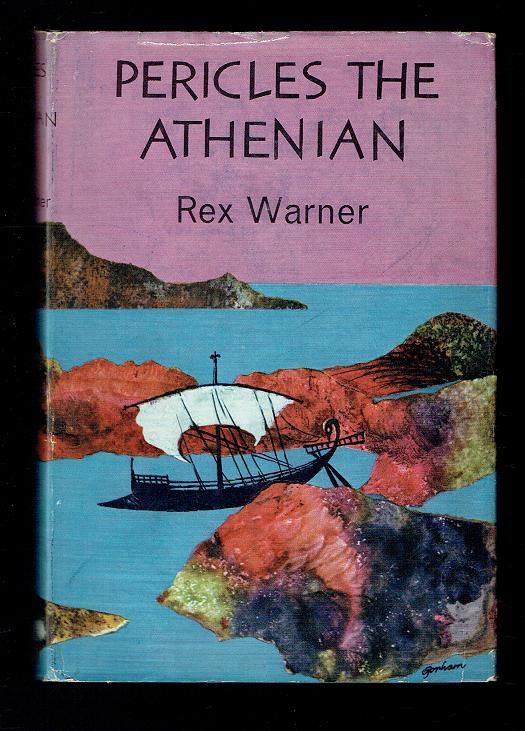
Rex Wagner's 196 Historical novel, Pericles the Athenian follows the famed Athenian leader from the end of the Persian War to his death during the early years of the Peloponnesian war. Told from the point of view of his friend and contemporary, the philosopher Anaxagoras, the novel works to describe how a man managed to lead Athens from it's near destruction at the end of the Persian War (Greece vs. the Persian Empire), into becoming the head of the Athenian Empire leading up to the Peloponnesian war (the war between Athens and Sparta).
This was my fifteenth book on the list of 36 Historical Novels set in Ancient Greece since January of last year, and although there was a lot I liked about it; Wagner is writing about an era in which we don't have a lot of primary sources to refer to and the fact that Athens at the time tended to exile any leader who got too powerful makes Pericles story quite the interesting one, I did feel at times that the book worked better as a textbook, or perhaps as creative non-fiction, rather than a perfect story on it's own.
An interesting read, but not one I would suggest as a starting point for people interested in the topic.