Nicolas Nicastro's 2005 novel The Isle of Stone takes a look at Spartan Society nearly sixty years after the battle of Thermopylae, specifically during the battle of Sphacteria (325 BCE). The novel focuses on two Spartan warriors, Antalcidas and Epitadas, brothers who were raised in two very different, but traditional Spartan styes.
Much like John Gardiner's The Wreckage of Agathon, The Isle of Stone looks at the Spartan Empire with a jaundiced eye. The empire is portrayed as brutal, and neither brother is drawn in a particularly heroic way. What I really liked about the novel was the character of the warrior's mother and her rationalization for why she helps one brother and hurts the other. The ethics of the Spartans, as described by Nicastro, definitely leave a lot to be desired.
The majority of the action of the story takes place with an army of Spartans under siege on a barren island surrounded by the Athenian navy. The story moves quickly and although I didn't like it as much as Nicastro's other work on the list (Antigone's Wake - which I LOVED!), it does work to give an unflinching look at a culture often celebrated in our modern day.

Continuing on my journey through Ancient Greece via historical novels, I've now moved passed the Persian War into the beginning of The Peloponnesian War (431–404 BC). This is the whole Athens versus Sparta war that lead to the rise of the Athenian Empire.
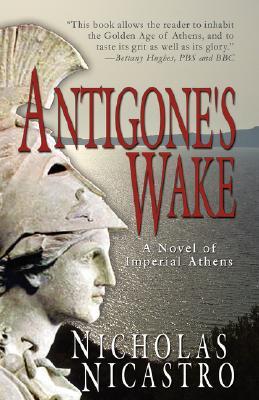
This month's book was Nicholas Nicastro's 2007 novel Antigone's Wake, which focused on the character of Sophocles (playwright of Antigone, Oedipus Rex, Electra, etc.), and his career in his early fifties as a military general for Athens.
The novel is short, to the point, and does a great job of painting its protagonist as a man in transition. Sophocles friend Pericles suggests that as Sophocles already knows how to effectively mount a stage play, why couldn't he use his skills towards military victory, and honestly, it would be a largely ceremonial role in response to his recent success with the play Antigone.
The story works quite nicely in painting Sophocles as a man near the top of his game thrust into a position he never trained for or wanted, and how he deals with some terrifying challenges, including his own teenage son coming along for an "adventure".
Considering that history largely focuses on Sophocles role as playwright, an examination of him as military leader was a real treat for me, and one that has me looking to view some of his plays before moving onto my read for next month, which in the end, is the mark of any successful historical fiction novel.


 Nicolas Nicastro's 2005 novel The Isle of Stone takes a look at Spartan Society nearly sixty years after the battle of Thermopylae, specifically during the battle of Sphacteria (325 BCE). The novel focuses on two Spartan warriors, Antalcidas and Epitadas, brothers who were raised in two very different, but traditional Spartan styes.