Showing posts with label Science Fiction: The 100 Best Books. Show all posts

Tuesday, January 3, 2017

I just finished a list it took me eight years to complete

Think of some long term goals you've had in life; marriage, wealth, kids, fantasy vacations, retire by 55, you know the type. Those sort of goals that sit just over the horizon waiting for you to catch up, and most of them feeling like there's not much you can do but wait and hope for the best.

Then think of those medium length goals, the sort of five-year-plan goals we have more often that require some work; propose marriage, get a degree, or even pay off your car.

Back in 2008 I had a dose of reality hit me when I heard about David Pringle's Science Fiction: The 100 Best Books Published in English between 1949 and 1984. The book began with George Orwell' s 1984 and ended with William Gibson's Nueromancer. As a huge science fiction fan and a voracious reader, I was fairly certain I would have read at least half of the novels he wrote about. Unfortunately for me; a then 32-year-old Canadian who counted the dozens of Star Trek and movie tie-in novels as a lot, Pringle's UK-focused list left me with a disappointing nine titles in total (four of which I had read as novel studies in Junior and Senior High School).

That left me with ninety-one books between where I thought I would be when I picked up the book, and where I found myself when I put it down.

So, I decided to start with the second book, Earth Abides (which would end up becoming one of my favourite novels period), by George R. Stewart, and try to read a book off of the list each month.

Two weeks ago, nearly eight years after I picked up Pringle's book, I finished John Calvin Bachelor's The Birth of the People's Republic of Antarctica (As a Canadian SF fan, I had read Nueromancer in my teens).

Here's what I learned along the way.

1) As my wife put it to me when I suggested starting a University degree part-time, "you'll be seven years older whether you do the work or not", and she was absolutely right.

2) I've now read my way through a list of books that were pretty good at the worst, and mind-blowing at their best, and honestly, I probably wouldn't have heard of half of these titles had I simply stuck to the SF section of my local bookstore.

3) I found the simple and yet amazing fact that if you take something big, break it down into manageable chunks, and consistently work at it, you can do all sorts of things - even if it takes you the better part of a decade.

BTW - my reward? Knowing that this is the kind of thing I can do with clear goals, consistent work, and a supportive network of friends and family.

What a great way to start a new year!

Sunday, December 11, 2016

Book Review: No Enemy But Time

As I near the end of making my way through David Pringle's Science Fiction: The 100 Best Books, I am increasingly glad for both the new finds and the authors I'm returning to again.

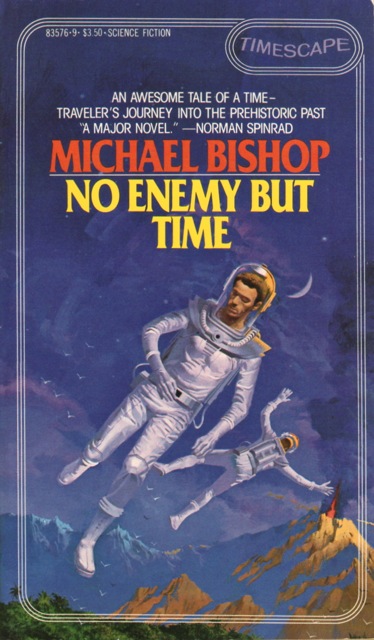
Case in point, last week I read Michael Bishop's 1982 Time Travel novel No Enemy But Time.  This was my third time reading a Bishop novel, but my first time reading his Science Fiction.  Previously I had read the horror novel Who Made Stevie Crye? and the Fantasy novel Brittle Innings and had really enjoyed both.

No Enemy But Time focuses on John Monegal, a chrononaut (Time Travelling explorer) who has been dreaming of the African Pleistocene era since birth, and with the help of an American agency begins the novel by travelling back in time to that specific era.

The novel moves back and forth between his study of the Homo Habilis people he finds in prehistoric Africa and his own life's journey that lead him to this point.

I found the novel fascinating throughout (but was a little confused as to why the cover image (seen above) depicts a white guy when the character is black), and enjoyed both John's journey from boy to man and his later journey with people who only see him as a strange creature.

As a man lost in time novel, it was a heck of a lot of fun, and leaves me interested in both finding more of Bishop's work, and of reading my next (and final) book on this crazy SF list I've been reading for nearly eight years now.

Wednesday, November 2, 2016

Book Review: The Complete Roderick, by John Sladek

With five titles left of my journey through David Pringle's Science Fiction: the 100 Best Books, I've just finished John Sladek's The Complete Roderick, which was originally published as Roderick (1980) and Roderick at Random (1983). The story is highly satirical and follows Roderick, the world's first self-aware robot, as he navigates his way through human culture.

Much of the novel is designed to make fun of the modern world from the point of view of an innocent. Roderick is created in a second-rate university hired by a representative from NASA who is only using the project to cover his own embezzling. As Roderick makes his way through the world (and to be fair, Roderick has no gender, so I should be saying "makes its way") it comes across all sorts of groups and institutions that simply refuse to see it as a robot, and instead assume Roderick is a disabled child. The novel doesn't have a lot of trust for larger institutions and is definitely against capitalism run amok, but at the same time shows how a creature unfamiliar with our world can construct a world view so alien as to seem impossible.

A fascinating read.

Friday, August 12, 2016

Book Review: Riddley Walker

Russell Hoban’s 1980 dystopian future novel Riddley Walker begins as follows:

On my naming day when I come 12 I gone front spear and kilt a wyld boar he parbly ben the las wyld pig on the Bundel Downs any how there hadnt ben none for a long time befor him nor I aint looking to see non agen.


The book, narrated by a young man called Riddley Walker, takes place some two thousand years after the end of our civilization in Inland (England), and is narrated by Riddley in a style that often requires passages to be read out loud if you'd like to make sense of them.

Although it felt a little gimmicky at first (I found Trainspotting, by Irvine Welsh, to be a similar reading experience initially), the writing style actually forces the reader to slow down and try to make sense of Riddley's world, which in many ways is exactly what he is trying to do throughout the story. In that way, the style definitely works, throwing the experience off kilter like Christopher Nolan's Memento (2000), which also uses format to put the viewer in the same place as the protagonist.

In some ways the novel reminded me of John Crowley's Engine Summer, as it also takes place well in a future where we are long gone and not particularly thought of at all, but for me Riddley works a little better with the language issue - I had plenty of "A HA!" moments while reading and deciphering his story, and the book would definitely hold up well upon rereads.

Saturday, August 6, 2016

Book Review: The Dreaming Dragons

Damien Broderick's The Dreaming Dragons begins with a simple premise; Alf Dean Djanyagirnji, an Australian anthropologist and his nephew are exploring caves in an attempt to find ancient representations of the Rainbow Serpent, a creator god in traditional Australian Aboriginal mythology. What they find instead leads to a secret military base, alien technology and the history of humanity itself.

Having read a lot of Science Fiction over the years, I have to say I haven't read a lot from Australia - Max Barry's Jennifer Government (an excellent book!) and a few fantasy novels by Sarah Douglass are the only ones that come to mind, so I was quite intrigued when I realized how focused this book was going to be on the region.

Although the book has a few flaws; not really any female characters of note, and extensive dream sequences (that do move the plot forward, but were often a little confusing to read), it's portrayal of the treatment of Aboriginal peoples in Australia's history is both harrowing and factual.

In the end, I found the book to be an interesting read, and like all good science fiction, a read that left me thinking a lot about who we are, and where we come from.

Thursday, July 28, 2016

Hitting my first science fiction novel of the 1980s on my list of David Pringle's Science Fiction: The 100 Best Books: An English Language Selection: 1949-1984 feels like a pretty big accomplishment. At this point I've read 94 of the 100 novels listed, and am really looking forward to completing this list.

Timescape (1980), by Gregory Benford follows two separate timelines, one beginning in 1998 and the other in 1962 and both follow scientists (two in an ecological disaster ridden United Kingdom in the later time frame and one a physicist in California in the earlier one). As modern attempts to stop a number of environmental blights have failed, a suggestion is made to send messages back in time using tachyons (faster than light particles) to the earlier time period and avoid the current mess altogether.

What I really enjoyed about this book was how, considering the book could definitely be considered Hard SF (focusing on technical or theoretical detail), an awful lot of the book focused on people and how they reacted to external stresses, all of the scientists families feature, and did a great job of showing just how hard it can be to live with someone so driven by their work.

The novel is pretty great, although not an action adventure like many of my favourite time travel stories, it works its way into your mind, making you ask questions about how time really works and how we perceive our pasts, presents and futures, which is actually a pretty good way to describe any great science fiction story.

Monday, November 16, 2015

Book Review: Engine Summer

Nearing the end of the 1970s in my reading of David Pringle's Science Fiction: The 100 Best Books Published in English from 1945 to 1985, I've hit my second book by author John Crowley, Engine Summer.

About a decade ago I read his 1981 fantasy book LIttle, Big, which focuses on a house, which is an entrance to the realm of Faerie, and a family tied to that world as well (it's pretty great).

Engine Summer (1979), takes place ages after us on a significantly depopulated Earth, among tribes (called chords) of peoples living as traders, farmers, hunters and gatherers. Among the people of Little Belaire we meet our hero, Rush That Speaks, a young man who's life changes when he falls in love with a girl called Once A Day, who soon leaves his community to join a group of travelers called Dr. Boots List.

Rush spends the novel travelling, attempting to find his way to either Once A Day, or perhaps to his own Sainthood, examining a world that has long since moved on from it's human populace. Perhaps the greatest strength of the book is it doesn't contain much backstory, requiring the reader to attempt to make sense of the story as they go along, keeping you in the moment with Rush throughout the narrative. The book would definitely benefit from multiple readings as plot points given later change much of what you've read before.

The world in Engine Summer is strange, haunting, and just as you begin to understand any specific setting, moves into stranger situations, still. At the same time, there are moments of humanity in the novel that completely caught me off guard, and truths for Rush that change everything.