Showing posts with label Terry Pratchett. Show all posts

Saturday, April 8, 2017

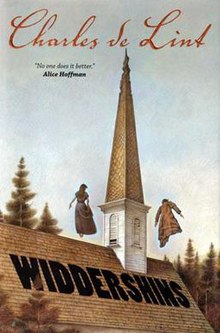
Book Review: Widdershins

One of my favourite things about reading Charles de Lint's Newford stories is how characters will pop up as main characters for a novel or a short story, and then step into the background for the next story; sure there are mainstays like the Riddell brothers or Jilly Coppercorn, but overall you get a different view of the city each time you go back sort of like Terry Pratchett did with Discworld.

Sometimes, however, you do really want to know what happens next, and in the latest of his books I've read, Widdershins, we follow up with Jilly a few years after the events of The Onion Girl and get to see what may be one of my favourite things in these types of stories, a collection of almost all my favourite characters over the twenty-years of stories working together to help a friend in need.

Like Louis L'Amour's The Sackett Brand (1965) or heck, even Kevin Smith's Jay and Silent Bob Strike Back (2001), this book is really for the fans. For the people like me who have been reading about Jilly and Geordie since the short story "Timeskip" back in 1989, this is a really fun reward.

Almost every new story de Lint sets in Newford works as a standalone, but I will say this one works best if you've read the short story collections, The Onion Girl and Spirit in the Wires.

Well worth reading, and as I'm nearing the point where I'm up to the books published ten years ago, I'm already starting to get nervous about when I'll have to wait like every other de Lint fan for his new books to come out.

Monday, December 7, 2015

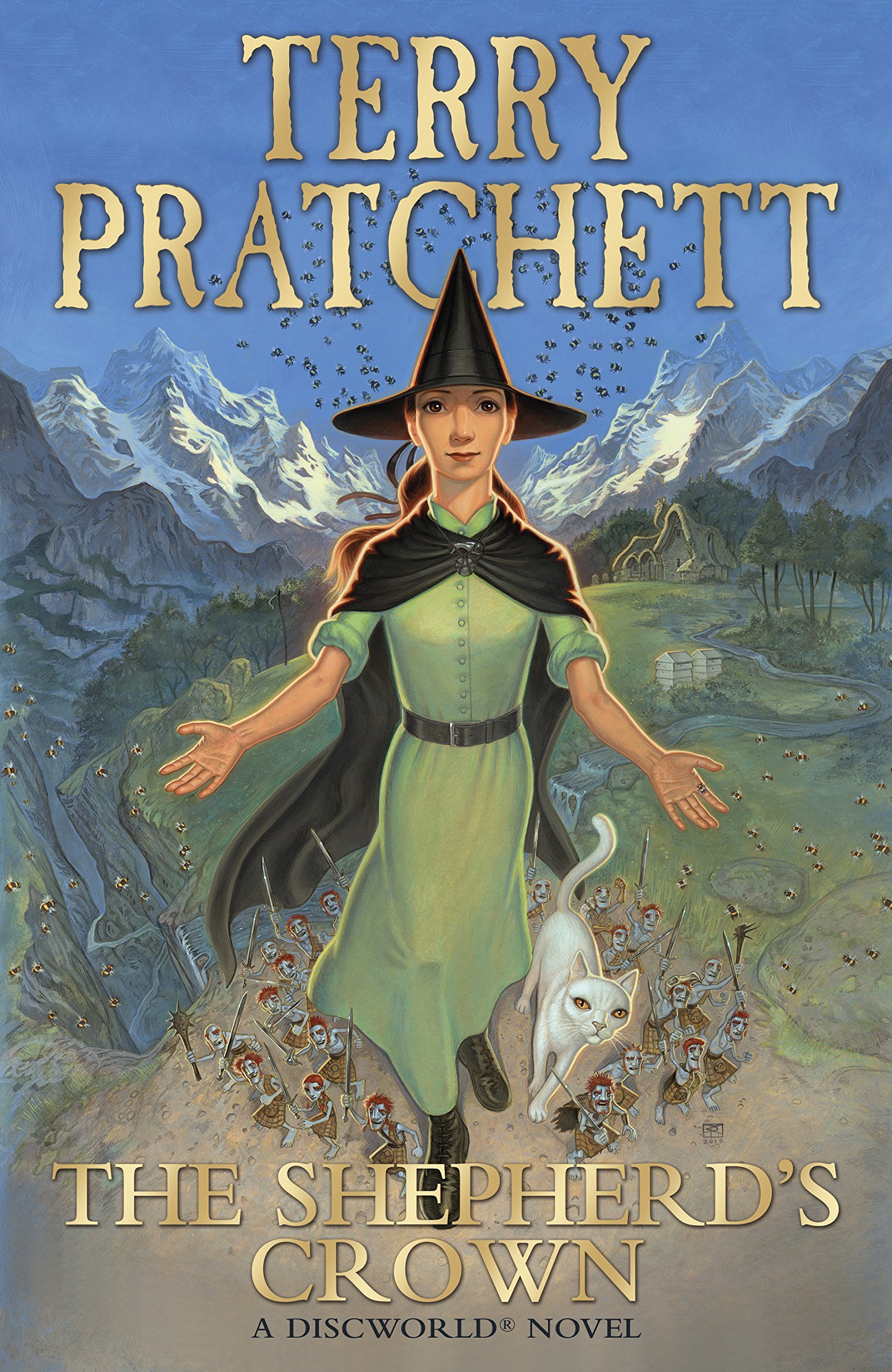
Book Review: The Shepherd's Crown

Not counting Good Omens (which I read back in 1990 when it was first published), I began reading the works of Terry Pratchett back in 2005, and at a book a month, it took me nearly five years to catch up to his prodigious output. Over those years in his books I met Rincewind, The Librarian, DEATH, Granny Weatherwax, Samuel Vines, and perhaps my favourite of his characters, Tiffany Aching.

Originally introduced as a nine-year-old cheese maker, Tiffany also happens to be, potentially, the most powerful witch in existence in Pratchett's Discworld series, and it is to Tiffany he returns in his final Discworld novel, The Shepherd's Crown.

The final book focuses largely on growing up, taking responsibility, and learning to understand the world around you. In the novel, Tiffany is faced with many choices, some very old, and a few quite new, but each needing to be addressed so she can become the adult she has been growing into over the five books she features in:

The Wee Free Men
(2003)
A Hat Full of Sky (2004)
Wintersmith (2006)
I Shall Wear Midnight (2010)
The Shepherd's Crown (2015)

The book is pretty delightful, although it was a bittersweet experience, as this is the final book ina series I've been enjoying for over a decade, and as with most of my favourite series, I wish there were more.

Saturday, November 21, 2015

Book Review: The Long Utopia

Terry Pratchett and Stephen Baxter's Long Earth has been quite a treat for me since The Long Earth was published back in 2012. Taking place on an Earth where citizens can "step" into parallel Earths, (basically the same as ours, excepting the fact that human's don't appear to naturally exist on any other Earth discovered so far), the series looks at how, over the course of decades, society would deal with the sudden appearance of effectively unlimited resources and land, simply a step away from everyone.

This book, the fourth of a projected five, was a little melancholy for me, as co-author Terry Pratchett passed away earlier this year, it's hard to read the book without realizing that you are coming down to the last few novels from this writer.

The Long Utopia continues the story from the third book in the series The Long Mars, but in this one an interesting twist is added. New creatures begin to appear in a parallel earth, but unlike humans who've got there by either stepping "east" or "west", these creatures have stepped in from somewhere else altogether, kind of like the sphere who tries to explain his three-dimensional world to a square in Edwin Abbott's Flatland.

Following along with the conceit from the previous novels, all of the main characters are now in their later fifties and early sixties, which definitely adds to the one dimension not benefited by the introduction of the Long Earth, time. No matter how much exploration the characters have been able to do across millions of parallel Earths in the series to date, they are all getting older and their stories will be ending soon.

A good read.

Friday, September 4, 2015

Book Review: The Scarlet Gospels

In my reading I have three favourite authors, three people who get space on my shelves no matter what, and although there are a few close seconds, so far no other author compares for space in my collection when it comes to Neil Gaiman, Terry Pratchett and Clive Barker (Although Charles de Lint is quickly moving into a strong contender for number four).

I've re-read all three authors a few times and still go back for more, so when a new book comes out, you can bet I'm chomping at the bit to crack that new spine and get reading.

Barker's latest, The Scarlet Gospels, combines two of his most famous characters - the demon known as Pinhead (introduced in his novella The Hellbound Heart - later adapted into the film Hellraiser), and Harry D'Amour (introduced in the short story "The Last Illusion" in Books of Blood volume 6 - later adapted into the film Lord of Illusions).  

Personally I enjoyed it, but as someone who has been looking forward to this book since he first mentioned it as an idea in the late 90s, I will say I felt it lived up to it's promise, and worked quite well as an extremely creepy read.

As with most of his books, I wouldn't recommend it to the faint of heart - it is filled with some truly gruesome and horrifying content, and as it focuses largely on characters from his previous works, I wouldn't recommend it as a  first dip into the books of Mr. Barker (check out Books of Blood for that).


Monday, March 16, 2015

RIP Terry Pratchett

Although I’m a pretty voracious reader, I can only think of six authors who have inspired me to read through their entire bodies of work; Terry Pratchett was my fourth.

I found my way to his work through Good Omens, co-written by Neil Gaiman (being the third author I’ve taken that journey with in my life) and absolutely loved the humour and adventure of that book. Quickly finding many of my friends had read a Discworld novel here or there, I decided to go back to his first book, The Carpet People (written at 18) and after finding it a fun read (with an even better “about the author” section*) I decided to read a Pratchett book a month until I caught up with his current work.

This took me from June, 2005 to July, 2008 - afterwards I waited, like all his other fans for each new book to come out and take to me some pretty great places.

Each month I was more and more stunned by how he could build a world from something as simple as a parody of Larry Niven’s Ringworld into something that started talking to me about my world, my life as a friend, husband, parent, and reader.

At the moment I’ve got all of his books sitting on my shelves from The Carpet People to last years The Long Mars and I can honestly say they are some of my favourites in genre fiction I’ve ever come across.

Kirk "Bookmonkey" MacLeod


*a section which stated in many of his books that “…started work as a journalist in 1965 and saw his first corpse three hours later, work experience meaning something in those days”**


**have I mentioned how much I loved his use of footnotes?

Saturday, August 9, 2014

Book Review: The Long Mars

This week I read the final novel in Terry Pratchett and Stephen Baxter's Long Earth sequence, The Long Mars.

As with the previous two books in the series, The Long Mars focuses on a near future world where technology has allowed mankind to "step" from our world to parallel Earths, only unlike in most parallel Earth fiction, these new worlds are largely unpopulated.

What I've loved about the series is how it plays with exactly how this sort of dramatic increase in resource would effect our world - if you move dozen (or even millions) of parallel Earths away from home and create your own town, why would you owe taxes to your home country?  If you can travel millions of worlds away, what could be billions of worlds away?

In The Long Earth, one of those worlds is simply called "the gap" in that version of Earth there actually isn't any Earth at all, simply a void where our planet should be - so certain scientists begin the process of building space stations there.  One of the real challenges of  space exploration is escaping Earth's gravity, so the ability to simply step into a space where the Earth isn't dramatically changes the resources required to explore our solar system.

In the end I loved this book, it was a lot of fun, and does feel like the end of a sequence, it plays around in both space and time (one of the story lines covers more than a decade while the others are limited to a few months) my only mild complaint about the book is that on page 287 there is a spoiler for Kim Stanley Robinson's Red Mars - although to be fair, that book was published 19 years ago, so part of the blame may lie with me.

Thursday, February 13, 2014

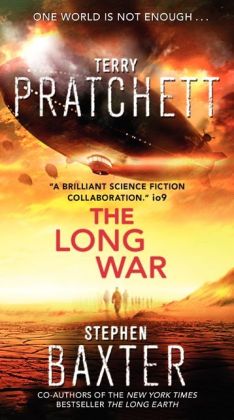
Book Review: The Long War

Yesterday I finished The Long War, Terry Pratchett and Stephen Baxter's follow-up to their 2012 novel The Long Earth.  The book takes place ten years after the discovery of The Long Earth, a series of parralel Earths accessible to most everyone on Earth; also when I say a series, I mean millions.

The book itself focuses on how governments across the world deal with a massive shift, being the exodus of their citizens into parallel versions of their own countries sometimes millions of worlds away.  Are these people still citizens?  Do they still pay taxes and require government services?

The book continues to follow the main characters from The Long Earth, and has both multiple story lines and in some of those story lines a quest format, but for me the most exciting bit was the sheer world building that goes on in the series.

The authors have already signed on for more books in the series, and if your interested in a great introductory novel to science fiction, the series is definitely worth a try.

Tuesday, December 4, 2012

Genre Character of the Week: Dodger


For the last few days I’ve been reading the new Terry Pratchett novel Dodger, which takes place in Victorian London and is a fun mix of historical cameos (both fictional and non-fictional) a mystery novel, and is overall a pretty great story.  In my opinion the main reason for this is our main character, Dodger.
 
Dodger is a seventeen-year-old tosher, meaning that he makes his living from scavenging through the sewers of London for lost coins, trinkets and other treasures.  Throughout the novel Dodger (named because of his quick ability to get away from would-be aggressors) moves through the London from Street level all the way up to the powers that be, and the whole way through he comes across as carefully descent, helping out where he can, but not so much as to be taken advantage of by others.
 
Helping him in the novel is journalist Charlie Dickens, and throughout the story he meets all sorts of folks – ranging from Benjamin Disreali to Sweeny Todd.  To be fair, my favourite historical cameo I’ve come across in the last few months is the “villainous” Charles Darwin who works as the bad guy in the family film The Pirates! Band of Misfits.  But the cameos in Dodger are a lot of fun as well.
 
In the end, what I like best about Dodger is his sense of right and wrong; considering he’s a guy who digs through the sewers everyday, he just comes across as someone who know the right thing to do in even the trickiest of situations.

Sunday, September 16, 2012

Book Review: The Long Earth


One of my favourite experiences in finding a new writer is when I’ve finally caught up with their published works and can start waiting for the new ones along with all their other fans.  For the past few years Terry Pratchett has been one of those I look forward to the most.  I read his discworld series and every other published book I of his I could get my hands on from 2004 – 2010 at the rate of one book a month and loved every one of them.
 
Last week I got a hold of his newest novel (co-authored with Stephen Baxter) The Long Earth, which I would describe as a science fiction novel taking place in a multiverse that borrows heavily from Larry Niven’s Ringworld and from Clifford D. Simaks Ring Around the Sun.
 
The story takes place on an alternate Earth where one day the plans for a dimensional hopper are transmitted around the globe through the Internet and soon the vast majority of Earth’s population begin travelling up and down (or, East and West as described in the book) many multiple Earths.  There is one strange thing however.
 
People don’t seem to exist in any of these Earths except our own.
 
The main character of the book is a young man named Joshua Valienté who is a particularly gifted “Stepper”, being someone who can step from world to world without the need for the gizmo virtually everyone else has to use.  Like Ringworld, the novel is very much a story of exploration, and although I did miss the standard footnotes which can sometimes be some of my favourite bits of any Pratchett novel, I did find the book to be fun, intriguing, and definitely worth the read.

Thursday, June 28, 2012

Things I've Noticed: The Bookmonkey FAQ part 1


One of the things I really enjoy reading on other peoples blogs are the various “Frequently Asked Questions” sections they have, and have decided to follow suit.
 
Only one real problem – I’m not frequently asked that many questions.
 
So.... I guess I’ll just ask myself some questions and then answer them, but I’ll list this as the Bookmonkey FAQ part 1 so that if I get some other questions in the next month or so I can answer them as well.
 
So here we go; questions 1 – 5
 
Where did you get the name Bookmonkey?
Totally easy – I’m a huge fan of the Terry Pratchett’s Discworld series, and my favourite character in the series is the librarian of Unseen University, who happens to be an organutan. The internet being what it is, Librarianmonkey, Oragutan-Librarian, Orangu-tarian, Discworldmonkey and a number of other names already existed, but Bookmonkey was up for grabs!
 
Why “The Wisdom” of Bookmonkey? 
Someday I hope to be remembered as a pretty wise guy (not a pretty wiseguy) and also I thought the title would be catchy and therefore easy to remember.
 
Whatever Happened to those “You Owe It To Yourself” posts you used to do?
Well, I got a good ten of them out there and then started worrying that they may be coming across as too lecture-y, so I took my favourite one and changed the topic to Genre Character of the Week.
 
Speaking of those different posts (You Owe it to yourself, Genre Character, Things I’ve Noticed, etc.) Whatever happened to my favourite Why I Love Horror
Honestly – I kind of lost track of that one, but should really get back into it.  Also I should figure out how the folks at Blogger will let me put links to each of those topics from my main page.
 
Finally, You spend each October looking at a popular topic in Horror (Re-imaginings, Twilight, and (mild Advertisement) the upcoming look at the Saw Franchise), so why don’t you dedicate a month to Fantasy or Science Fiction each year?
Honestly?  Those month-long sessions take a lot of my time; I need to design artwork and get my BFF Mike to create a new banner, I actually have to watch/read everything I want to talk about, and finally, my wife only has so much patience for me to spend time focusing on a topic of little interest to her (October 2010 – The Twilight Saga, was a long and lonely month for her).
 
So there you go – if any of you out there have questions you’d like to know the answer to, feel free to send them my way, either by the comments or a simple email to bookmonkey00k@yahoo.ca
 

Tuesday, January 24, 2012

Genre Character of the Week: Samuel Vimes

One of my favourite times of the year is in January, when I go looking through all my lists to figure out which new books by my favourite authors are due out over the next year. In 2011 I had a list of six books I was looking forward to above all others, all of which except two ended up as reviews on my blog (the first missing title was Dead Reckoning, by Charlaine Harris, but as it was book 11 of an ongoing series, I couldn’t figure out how to review it without giving away massive spoilers). The final book was Terry Pratchett’s Snuff, featuring my favourite character in his Discworld stories, Samuel Vimes.

A few years ago I reviewed Matthew Scott’s Thraxas, a novel which paired the hard-boiled detective novel with a fantasy setting. In Terry Pratchett’s Discworld novels, the author has satirized and parodied so many types of stories with his own fantasy world I wouldn’t know where to begin (but I suppose if you want to, you should start with The Colour of Magic, which parodies everything from classic fantasy to tourism and even Fritz Lieber’s Fafhrd and the Grey Mouser), but for me my personal favourite novels are his cop stories, which he calls his City Watch novels (including, Guards! Guards!, Men at Arms, Feet of Clay, Jingo, The Fifth Elephant, Night Watch, Thud!, and Snuff) and a major part of this is the captain of the city watch, Samuel Vimes.

Now, a huge part of what I like about Sam is his growth throughout the series of books he features in, and like one of my favourite SF Genre characters, Miles Vorkosigan, Sam does an awful lot over the course of these stories. But looking back at his character in his first book,Guards! Guards!, Sam comes across as a good cop, trying to balance his own views about the importance of law and order with his experience in leading the city watch of Ankh Morpork, a wretched hive of scum and villainy if there ever was one.

In the end, he’s a decent guy trying to do his best in a less than great situation, something we can all aspire to.

Tuesday, March 1, 2011

Genre Character of the Week: Tiffany Aching

When you talk about a writer who has books numbering in the dozens it can be tricky to find the character you feel most connected to (especially if he has more than one main character). In the case of Terry Pratchett’s discworld series of novels there are at least half a dozen characters I’m very attached to, but as this is genre character of the week not genre ensemble of the week, I have to pick favourites, and in terms of discworld, my favourite is a girl we met at age nine in the book The Wee Free Men, Tiffany Aching.

Through four incredible Young Adult novels (being, in order, The Wee Free Men, A Hatful of Sky, Wintersmith, and I Shall Wear Midnight), author Terry Pratchett has created a young girl who is both sympathetic and terrifying. Tiffany begins her journey in pursuit of a missing younger brother, ends up fighting faerie queens and the personification of Winter and eventually ends up featuring in what might be my favourite ending of a fantasy book I’ve ever come across.

At her heart, Tiffany is a young girl from a small rural community who is quite talented at making great cheese (a talent she never downplays, regardless of how formidable her witching prowess becomes), she is very focused on getting things done and has the ability to not just think about things, but to think about the way she thinks about things.

If you’ve never cracked a Discworld novel before, and don’t want to start way back at the beginning (the books are a shared world series, so with some exceptions you can read them in virtually any order) the four books featuring young Miss Aching would be a wonderful place to start exploring the series.

Thursday, December 30, 2010

Things I've Noticed: Sometimes it's easy to forget the books you want to read

As we begin counting down the hours left of 2010, I started thinking of the books that came out this year I haven't got around to reading yet, the ones I mean to read but simply haven't had the time to check out.

Here are the four books of 2010 I haven't got around to yet, and am really looking forward to reading.

Blue-Eyed Devil and Painted Ladies by Robert B. Parker
I came to Parker late, reading his first novel in August of 2006, but from that point on, I read one of his books a month until 2009, when I caught up with his current books. Basically they are detective stories, featuring either Spenser (the basis for Spenser for Hire), Jesse Stone or Sunny Randall. All of his books are a fun read and as he passed away earlier this year, I've both been looking forward to, and dreading reading his last few works. I know I'll like them, but I'll be sad when there won't be any more new ones for me.

I Shall Wear Midnight, by Terry Pratchett
I started reading Terry Pratchett books in June of 2005, again at the rate of one a month and if you've never tried any of his books, definitely give them a shot - they are just the perfect mix of comedy and fantasy, and they also happened to inspire my online name, Bookmonkey00k. This book is the fourth in a series focusing on a young witch called Tiffany and her varied adventures.

The Last Run, by Greg Rucka
Over the last few years, my tastes in non-genre works have moved into the spy genre. Earlier this year my wife and I watched possibly the coolest spy series I've ever seen; The Sandbaggers, a gritty '70s era show out of the UK focusing on the people who send out the people on the missions that help keep the world safe (if you haven't seen it, the series is definitely worth a viewing). Comic book wise, I took the time this year to read Greg Rucka's Queen & Country series, which, after telling a story through four large graphic novels, moved into a couple of prose novels to wrap things up. In October, the latest book in his series has come out, and I'll definitely be checking it out in January.

Wednesday, September 23, 2009

You Owe it to yourself #6: Reading your favourite Author more effectively


One morning while reading the paper I was struck by an interesting idea - what if you read all of an author's books in chronological order? Would it change your perception of the world? Would it change me from a black-and-white '50s Dad into some sort of demented bookmonkey? Only one was to find out.

I started the habit back in 2003 - never having read any crime fiction I thougt I would try some Elmore Leonard, and more specifically, I would read his books in the order he wrote them. I had just finished reading all of Louis L'Amour and as Leonard started with Westerns before he moved to crime fiction, I figured it would simply be a fun couple of months reading.

6 months and 40 novels later, my reading habits had changed. I was hooked on reading authors in publication order.

What I noticed as I went through Elmore Leonard's books (his first novel, The Bounty Hunters, was published in 1953) was that over time, the quality improved. I love his early stuff (again, big fan of westerns - thanks Mom), but by reading his books in order I could see that over time his pacing, his descriptions and his already amazing dialogue just get better and better.

I only had two problems with my experiment: first, reading 40 books of a similar style and tone in 6 months kind of made all their plots run together, secondly, it felt really cool to read an author like that, really, REALLY cool - I had to do it again.

The next author I tried this with (starting in July of 2004) was Terry Pratchett, and to solve my first problem I limited myself to one book of his a month. I just caught up with him this spring (March 2009). Pratchett wrote his first book - The Carpet People, when he was 17 years old, so again, over the course of nearly 50 books and 30+ years I got to see the evolution of a writer.

Since then I've done the same with a few more writers - Lois McMaster-Bujold, Michael Crichton, Robert B. Parker, Pierre Burton, and Robert R. McCammon, next up is Canadian fantasy author Charles De Lint.

The rewards are great - especially if you are personally looking to get into writing yourself. What I do not recommend is doing this with an untested author - often their first book is the worst place to start - read something you've heard good things about first, and once you've decided you want to commit, then you can go back to the beginning.

It'll show you a lot of stuff about the writer you might not have noticed before, which will make you appear much smarter (and slightly annoying) to your friends and family.

If you've already done this - congrats - get yourself a celebratory piece of cake and send me a comment letting me know about your experience, otherwise give it a try, after all, you owe it to yourself.