Showing posts with label Mary Renault. Show all posts

Thursday, September 13, 2018

Book Review: Funeral Games

Funeral Games, Mary Renault's final novel, and the conclusion of her Alexander trilogy follows the aftermath of the death of the Macedonian King, and how quickly everything can fall apart without any plans for succession.

The story is bloodthirsty and often heartbreaking, following both those who lust for the power left in Alexander's wake and those thrust into positions of power with little but their wits to protect them. In previous novels Renault largely focused on male protagonists, but here she has his widows, mother, sister and cousin all feature prominently and although history clearly shows how his empire worked out after his death, I couldn't help but root for many of these characters.

A fascinating look at how quickly events can turn on just about anyone, Funeral Games was well worth the read, and will have me looking for other Renault books in the future.

Thursday, April 26, 2018

Book Review: The Virtues of War

As I continue to work my way through this list of 36 Historical novels covering Ancient Greece, two names always bring a smile to my face as they reoccur, Mary Renault and Steven Pressfield. Renault's work gives such an interesting look at aspects of the Ancient world I'm not as familiar with, such as the lives of actors, poets, and even occasionally, kings. Pressfield, on the other hand, wows me both with spectacle and how he pairs ancient philosophies with the events he describes.

His 2004 novel, The Virtues of War begins with Alexander the Great nearing the end of his conquest in India, and looks back across his life at many of the key battles he fought. Pressfield works hard to show Alexander's military genius and after reading Scott Oden's Memnon, I found myself approaching the battles between Alexander and the Persian general with trepidation; I knew how everything would turn out, but had previously only seen it from the other side.

The novel was a really great look at Alexander's world from his own point of view, and although perhaps not as lyrical as Renault treated the same source material, a really excellent read.


Tuesday, November 21, 2017

Book Review: The Mask of Apollo

Mary Renault's The Mask of Apollo focuses on Nikeratos, an actor of some repute living in Syracuse in the aftermath of the reign of the tyrant Dionysius.

The book does a remarkable job of following a society in which a young man (Dionysius II) has been placed in control entirely in conflict with the fact that he is not a leader, doesn't care for his people and wishes to spend all his time at his hobbies.

The novel focuses largely on the lives of actors in the era and seeing the story of a young man's professional career against the backdrop of great change in the world (Alexander the Great's father Phillip of Macedon makes an appearance in the framing chapters of the story).

A remarkable read and one that has me looking forward to the remaining three Renault novel's I'll be reading next year as I finish my read through this list.

Saturday, July 1, 2017

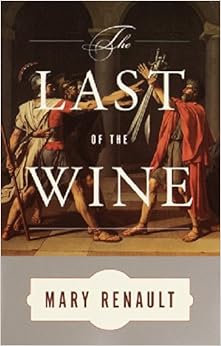
Book Review: The Last of the Wine

As I'm working my way through this list of 36 Historical Novels set in Ancient Greece, there are a few authors I'm always happy to get to, Christian Cameron and Steven Pressfield novels both make for excellent reads, but so far my clear favourites are the novels of Mary Renault.

Renault (1905-1983) wrote a number of both contemporary and historical fiction novels, but is most well-known for her works set in Ancient Greece. At this point I've read The King Must Die, The Bull From the Sea, and The Praise Singer, so I was definitely looking forward to The Last of the Wine. The novel takes place during the Peloponnesian War and follows a young man called Alexias, who is famed for both his beauty and his running.

Unlike most of the novels I've read off of the list (17 others to date), The Last of the Wine is largely focused on the lives of the Athenians in Athens. The novel focuses on Alexias teenaged and adult years and portrays the lives of young Athenian men almost as wealthy socialites. Renault does not shy away from homosexuality in the setting, indeed Alexias' father recommends he takes an older lover, and the love of Alexias's life is a man called Lysis. Both men are disciples of Socrates (who figures large in the story) and much of story involves how Alexias deals with his love for his friend over their lives.

A fascinating read and a picture of Athenian life that is too often shown in historical fiction as entirely focused on warfare.

Wednesday, August 10, 2016

Book Review: The Praise Singer

Continuing my journey through Ancient Greece in Historical Fiction, I've just finished Mary Renault's 1978 novel The Praise Singer, focusing on the lyric poet Simonides of Keos (556 BCE- 469 BCE).

The novel follows the narrator through his boyhood and into his fame from his point of view as an older man, and for me, this lens was a big part of what I really loved about the book. Early on, Simonides runs away from home to attempt to become apprenticed to a visiting poet, only to find out that his own father would have been happy to apprentice him to any poet, if only Simonides had ever let his passion for poetry be known. As a parent myself, this glimpse of missed opportunity felt especially heartbreaking.

Unlike her previous two books I've read on this list The King Must Die (1958) and The Bull From the Sea (1962), which followed the mythological figure Theseus, there isn't a lot action in this book, which focuses more on the power of words and poetry, as well as the movement from oral to written tradition. The reliability of the characters however, made for a pretty enthralling read, and considering I had never heard of Simonides of Keos before, definitely had me interested in learning more.

Tuesday, April 19, 2016

Book Review: The Golden Fleece

Continuing to work my way through the Bronze age of Ancient Greece in historical fiction novels, I've just finished Robert Graves look at Jason and Argonauts in The Golden Fleece (1944).

From a modern perspective the book is a little tricky to read as the cadence of the prose worked differently than modern text, so it took some time to get comfortably into the reading. Past that, the book has a massive amount of background information on early religion and mythology, that at times was a little too detailed for me (moving much closer to his nonfiction book The White Goddess, 1948), but once the crew of the Argonaut gets moving the story began to work quite nicely as a series of adventures including Jason, Hercules and Orpheus, all of which had nice character moments throughout.

Unlike Mary Renault or Steven Pressfield's work on the story of Theseus, Graves story is quite omfortable including gods and magic throughout, sticking closer to the mythology than focusing on the "story-behind-the-story" format of the books I've read so far on the list.

Although I didn't enjoy it as my as his earlier work (Goodbye to All That, 1929, I Claudius 1934, and Claudius the God 1935), I did find the story rewarding and am looking forward to the next on the list The Iliad, by Homer.

Friday, March 18, 2016

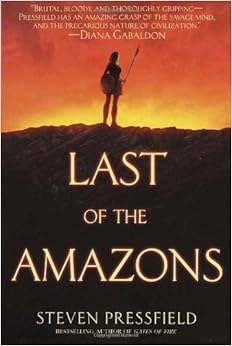
Book Review: Last of the Amazons

My third historical novel focusing on Ancient Greece (specifically the Bronze Age) is Last of the Amazons (2002) by Steven Pressfield. Although the story focuses largely on the same events from Mary Renault’s The Bull from the Sea (1962), the perspective is entirely different.

The story works as flashbacks within flashbacks; following a character called Mother Bones, who, in her youth, along with her older sister, was raised by an Amazon survivor of the Athenian-Amazon war in fifth-century BCE Greece. As Theseus (yes, the fellow who beat the Minotaur) features as a main character in the novel, it firmly straddles history and mythology, but for me, one of the most fascinating parts of the novel was its structure.

Narrated in turns by Mother Bones, who recalls stories told to her by her Governess Selene, and after the key event of the novel, also includes narration by both Mother Bones father and uncle, a picture is painted of one of the most brutal wars I’ve read about in fiction. Much like the female horse-riding clans in Suzy McKee Charnas’ Holdfast series, the novel attempts to paint of picture of a warrior woman culture and how it would look in times of peace, dispute, and war, and yes, when we get into the violence of the novel it is brutal.


An intriguing read, and definitely one that will lead me to checking out other books by the same author.

Tuesday, February 16, 2016

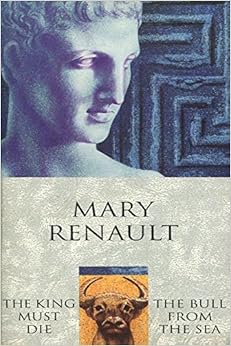
Book Reviews: The King Must Die & The Bull from the Sea

So this year, five years after finishing my Bachelors degree, I was feeling a little nostalgic for my favourite elective courses at Athabasca University, Ancient Greece, and Rome and Early Christianity I and II. Yup, we're talking Classics, and for me, a guy who majored in communication studies, I was just surprised to see how often a little knowledge of early Western Civilization would pay off in courses on Communications Theory, History, and specific communications mediums (Radio, TV, The Internet, etc.).

So I decided to take a look around for some great historical fiction to read taking place during the era and found this website: Historicalnovels.info which literally has a page entitled "The 36 Best Historical Novels for a Survey of Ancient Greek History" by David Maclaine.

The first two novels on the list were both by an English author I had never heard of, Mary Renault, and focused on a retelling of the life of Theseus (Greek Mythological Hero, sent to Crete, put in a labyrinth, fought the Minotaur), The King Must Die (1958) and The Bull From the Sea (1962).

These two books, told directly from Theseus' perspective, were incredibly immersive and painted a pretty clear picture of Bronze Age Greece. The look at the cultures displayed was fascinating, seeing the story-behind-the-legend was enlightening, and although I'll be the first to admit that historical fiction is not a fair replacement for history, it can give a flavour and context to what otherwise can come across as a series of dates, events, and names.

The first of the two books was a little better than the second, but to be fair Theseus does most of his best stuff early on, and then a lot of terrible things happen so the second book had to work within that constraint.

A fascinating beginning to the a list of books I'm looking forward to reading over the next few years.

Well worth checking out!