Showing posts with label Steven Pressfield. Show all posts

Friday, July 13, 2018

Book Review: The Afghan Campaign

My fifth book by Steven Pressfield, and his fifth on the list, The Afghan Campaign (2006) takes a look at a specific era in the Macedonian King's conquest of empire during 330 BCE when he attempted to subdue the Afghan kingdoms (modern day Afghanistan). The novel focuses on a recent recruit called Matthias who begins the book by running away from home to join the military, where both his older brothers have enlisted.

Following Matthias on his journey the book begins to feel like a young man coming of age story, then a love story, and then a meditation on the costs of war. Much of the novel focuses on cultural differences between the Macedonian army and those it battles, and Matthias makes a number of clear missteps throughout the book from a place of good intentions but almost total ignorance of the people he is either liberating or conquering, depending on your point of view.

When I tell people I've spent the last few years working my way through this specific list, I'm often asked what draws me to these stories of Ancient Greece, and with certain novels, like John Gardiner's The Wreckage of Agathon or this title by Pressfield, I find the answer is that much of the issues dealt with at that time are still very close to us here are the beginning of the 21st century.

A fascinating read.

Thursday, April 26, 2018

Book Review: The Virtues of War

As I continue to work my way through this list of 36 Historical novels covering Ancient Greece, two names always bring a smile to my face as they reoccur, Mary Renault and Steven Pressfield. Renault's work gives such an interesting look at aspects of the Ancient world I'm not as familiar with, such as the lives of actors, poets, and even occasionally, kings. Pressfield, on the other hand, wows me both with spectacle and how he pairs ancient philosophies with the events he describes.

His 2004 novel, The Virtues of War begins with Alexander the Great nearing the end of his conquest in India, and looks back across his life at many of the key battles he fought. Pressfield works hard to show Alexander's military genius and after reading Scott Oden's Memnon, I found myself approaching the battles between Alexander and the Persian general with trepidation; I knew how everything would turn out, but had previously only seen it from the other side.

The novel was a really great look at Alexander's world from his own point of view, and although perhaps not as lyrical as Renault treated the same source material, a really excellent read.


Wednesday, April 19, 2017

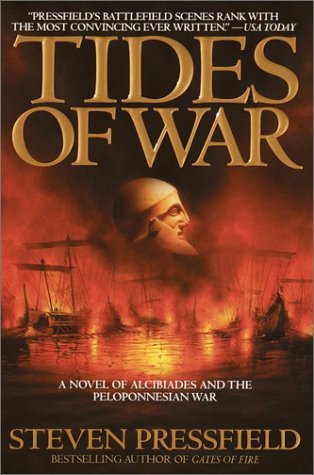
Book Review: Tides of War

My third novel by Steven Pressfield on this tour of Ancient Greece through Historical Fiction, Tides of War takes place well after the events of The Last Amazon and Gates of Fire, but as with those previous novels, gets deep into the world of Ancient Greece and gives the reader a rare taste of the values and thoughts in world.

Taking place during the Peloponnesian War, Tides of War follows Alcibiades, the nephew of Pericles and one of the greatest generals of the Ancient World. The story is told through two layers; our narrator is interviewing the man responsible for Alcibiades death, who in turn is narrating his life alongside the general over this many campaigns.

What I found most interesting about the story was how little I knew about the general going in; when I've read previous works about Theseus or Sappho or Leonidas, I was at least a little familiar with their lives (Minotaur, Poetress, Spartan King), so when I started reading about a general who switched sides from Athenian to Spartan and even to Persian, I was quite surprised by just how unfamiliar I was with the historical figure. It did lead me to more than a couple quick stops at wikipedia to get a better grasp on the character, but as these books often do, I found it was well worth the distraction.

An intriguing introduction to the Peloponnesian War, and one that leaves me looking forward to the next book off of the list, Isle of Stone by Nicholas Nicastro, with more than a little excitement.

Thursday, January 5, 2017

Book Review: Gates of Fire

Finishing my first year of reading historical fiction set in Ancient Greece, I read my second Steven Pressfield novel, Gates of Fire. This one focused on the Battle of Thermopylae between Sparta and the Persian Empire. Similar to Gary Jenning's 1980 novel Aztec, Gates of Fire is told from the point of view of the victors of the battle interviewing a lone survivor, and works to paint a view of a society in the era leading up to the battle in question.

In Pressfield's book, the character is Xeones, a volunteer in the Spartan army (which would mean he wasn't a true citizen of Sparta), who is able to tell his own life story, as well as why he volunteered to join with a city that would never consider him to be a full citizen and further, why he would join the Three Hundred Spartan in a battle that was sure to end in their deaths.

The novel was incredibly immersive and powerful, and left me with no question as to why this book was so well received and sits on the recommended reading lists of so many military forces throughout the world.

As much as I've enjoyed every one of the twelve novels I've read off this list to date, Gates of Fire alone would have made reading the list worthwhile.

A great book.

Tuesday, April 19, 2016

Book Review: The Golden Fleece

Continuing to work my way through the Bronze age of Ancient Greece in historical fiction novels, I've just finished Robert Graves look at Jason and Argonauts in The Golden Fleece (1944).

From a modern perspective the book is a little tricky to read as the cadence of the prose worked differently than modern text, so it took some time to get comfortably into the reading. Past that, the book has a massive amount of background information on early religion and mythology, that at times was a little too detailed for me (moving much closer to his nonfiction book The White Goddess, 1948), but once the crew of the Argonaut gets moving the story began to work quite nicely as a series of adventures including Jason, Hercules and Orpheus, all of which had nice character moments throughout.

Unlike Mary Renault or Steven Pressfield's work on the story of Theseus, Graves story is quite omfortable including gods and magic throughout, sticking closer to the mythology than focusing on the "story-behind-the-story" format of the books I've read so far on the list.

Although I didn't enjoy it as my as his earlier work (Goodbye to All That, 1929, I Claudius 1934, and Claudius the God 1935), I did find the story rewarding and am looking forward to the next on the list The Iliad, by Homer.

Friday, March 18, 2016

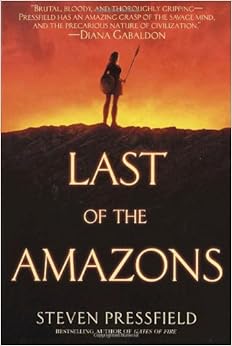
Book Review: Last of the Amazons

My third historical novel focusing on Ancient Greece (specifically the Bronze Age) is Last of the Amazons (2002) by Steven Pressfield. Although the story focuses largely on the same events from Mary Renault’s The Bull from the Sea (1962), the perspective is entirely different.

The story works as flashbacks within flashbacks; following a character called Mother Bones, who, in her youth, along with her older sister, was raised by an Amazon survivor of the Athenian-Amazon war in fifth-century BCE Greece. As Theseus (yes, the fellow who beat the Minotaur) features as a main character in the novel, it firmly straddles history and mythology, but for me, one of the most fascinating parts of the novel was its structure.

Narrated in turns by Mother Bones, who recalls stories told to her by her Governess Selene, and after the key event of the novel, also includes narration by both Mother Bones father and uncle, a picture is painted of one of the most brutal wars I’ve read about in fiction. Much like the female horse-riding clans in Suzy McKee Charnas’ Holdfast series, the novel attempts to paint of picture of a warrior woman culture and how it would look in times of peace, dispute, and war, and yes, when we get into the violence of the novel it is brutal.


An intriguing read, and definitely one that will lead me to checking out other books by the same author.