Showing posts with label Science Fiction. Show all posts

Wednesday, June 17, 2020

Book Review: To Your Scattered Bodies Go

Each month I make sure to read some science fiction, partially because I like a lot of the tropes: dystopias, Utopias, time and space travel, aliens, robots, and the FUTURE! but another key reason I like to read the genre regularly is that in many ways it is dangerous fiction. It gets me thinking about concepts and my own preconceived notions, looking at problems from another angle, and in many ways, seeing how the human spirit endures.

This doesn't mean I don't like reading some good meat and potatoes style space operas, but it does mean I get to look forward every month to reading something that might really surprise me.

A case in point is Phillip JosƩ Farmer's To Your Scattered Bodies Go. This 1971, Hugo Award winning novel, and the beginning of his Riverworld Series. The conceit of the novel is simple, what if after dying you woke up on a strange world, and everyone was there? Literally everyone, all of human history, going to our prehistoric era and ending at the Earth's demise. You just wake up, find yourself in a field and back in your mid-twenties, along with people from across Earth's space and history.

There's no clear messaging, no one to tell you what to do, and yes, although many people believe you're now all in heaven, something don't match up - the stars are different, and many of the people here are not the people you thought would be rewarded with any sort of afterlife...

Why are we here, and for what reason?

The book follows famed British explorer Sir Richard Burton as he awakens and tries to makes sense of the strange new world he finds himself in.  Societies and religions begin to spring up, but again there is no clear answer as to why everyone is brought back and exactly where they have all ended up.

The novel is largely one of exploration, both physically, as Burton travels down a river which seems to connect this entire world, and existentially, as everyone he meets seems to have a clear understanding of the reasons, but with no proof.  I found it to be a fascinating read, and will keep an eye out for any other books in the series in future.

Wednesday, March 6, 2019

Book Review: Hazards of Time Travel, by Joyce Carol Oates

So I picked up Joyce Carol Oates Hazards of Time Travel simply because I liked the title and I'd enjoyed her 1995 novel Zombie. The book starts in a dystopian future and follows a young woman named Adriane Strohl through her last few days of high school and her subsequent imprisonment in a University in 1959 Wisconsin.

On the surface, the book felt a lot like 12 Monkeys to me, wherein our protagonist is punished by being sent somewhere that is arguably better than where they came from. Are there problems? Absolutely, Oates has found a great way to highlight the negatives of late '50s America by showing it as a University based on blandness, everyone working hard to be consistently forgettable. Renamed Mary Ellen, Adriane stumbles through her first year learning and relearning exactly how closed off America was during the period and for me, some of the greatest strengths of the book come from the character study of Mary Ellen/Adriane, rather than the dystopian future or the science of the time travel.

An interesting read that left me with more questions than answers, but honestly, isn't that what we want from speculative fiction?

Thursday, December 27, 2018

Book Review: Dark Matter


Last month I read Blake Crouch's Dark Matter for one of my book clubs, as a selection by my friend Ron. The novel (which I really enjoyed), follows Jason Desson, a college physics professor, who, after being kidnapped, wakes up in a strange new world, one where he is not married, not a father, and is instead a world renowned physicist. He's wealthy, well regarded and lives in an amazing version of his old home, and somehow, he's managed to create a door (spoilers follow) between worlds.

The book follows Jason as he attempts to reconcile his new life with his old and eventually, tries to leave it all together. As a story it follows an action/science fiction plot, and I imagine that if I hadn't seen a number of dimension-hopping stories before (Sliders, Ring Around the Sun, etc.), it may have took me a little longer to see where the novel was headed.

The book is quite engrossing, keeping up a really great pace and if you are not as familiar with this sub-genre of science fiction, it could be a gateway novel to a lot of really fun reads. It had a number of set pieces that worked extremely well (including the climax) and definitely has me interested in reading more from the author.

Thursday, August 9, 2018

Book Review: The Rise and Fall of D.O.D.O.

In Neal Stephenson and Nicole Galland's 2017 novel The Rise and Fall of D.O.D.O. mixes the speculative fiction concept of time-travel with government bureaucracy and although it was a touch long for my taste, it was, in the end, a fun examination of how bureaucracies can ruin pretty much everything.

The novel follows a Linguistics doctor named Melisande Stokes, who after having a particularly disastrous run in with her academic supervisor, runs into a mysterious government officer who offers her a job.

The majority of the novel is told from Melisande's point of view, and is written as a document she has deposited in a bank from Victoria England, where she has been trapped in the past.  Other characters and story elements get focus through internal memos, newspaper clippings, personal journals, etc.

The novel focuses on exactly how a government agency might go about setting itself up with a time-travel based department, and the increasingly byzantine obligations put on it as its importance raises over time.

Although it works strongest in concepts, rather than person to person interaction, in the end I found it to be quite a fun read.

Wednesday, June 20, 2018

Book Review: Head On

John Scalzi's follow up to his 2014 book Lock In continues to follow FBI Agents Chris Shane and Leslie Vann as they examine an accidental death/potential homicide during a game of Hilketa, an especially violent professional sport specifically for Hadens (the 1% of the population locked in to their own bodies and forced to explore the world either online or through surrogate robots called Threeps).

The novel works as a fairly fun action mystery and speaking as someone who is not particularly interested in professional sports, I still found it to be a really fun read read and one that continued to expand and eplore the world that Scalzi created in the first novel.

Well worth a look, although I'd strongly recommend you read the first novel before digging into this one.

Wednesday, December 6, 2017

Book Review: Artemis

Andy Weir's 2017 follow up to The Martian, Artemis follows the story of a young woman, Jasmine "Jazz" Bashara who works as a porter on the lunar city of Artemis.

As with The Martian, much of the novel comes down to timing and problem solving, but unlike his first work, a clear man vs. nature story, Weir has created an entire society with Artemis, working to outline its economy, class structure and characters ranging from the porter/smuggler protagonist through to city leaders, technical staff, the police and others.

The story moves along quickly and with a great sense of tension as Jazz takes a simple job that quickly becomes complicated and then moves straight into some truly dangerous and exciting territory.

A really fun read and well worth the look.

Tuesday, August 1, 2017

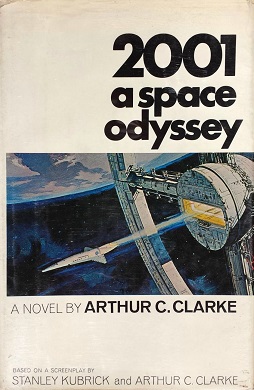
Book Review: 2001 A Space Odyssey

So here's the thing about perspective. For so many people Stanley Kubrick's 1968 film 2001: A Space Odyssey is pretty much the paragon of what a Science Fiction film should be, for me however, first watching it at about the age of twelve when Science Fiction meant Star Trek, Star Wars and Aliens, 2001 was a really hard film to get through. The story moved incredibly slowly, the character with the most intrigue wasn't even human and the humans are largely forgettable.

At the time, I just didn't see what the big deal was, but as a completionist, I decided to give the companion novel by Arthur C. Clarke a try.

Reading it at the age of twelve, the novel moved along quickly enough, and suddenly a number of the images from the film started to make sense to me. It still wasn't my favourite science fiction novel (at the age of twelve that probably would have been Vonda N. McIntyre's novelization of Star Trek: The Wrath of Khan, but I was able to acknowledge it as a big part of the genre.

As part of my recent read through of the various Penguin Galaxy imprint, I reread 2001 last month, and I've got to say from the point of a forty-year-old father and avid genre reader, the story was much more compelling. The narrative moves along through three separate sections (the monkeys, the scientist, and the astronauts), and I thought it all held together rather well.

I guess it's time I take another look at the film, because, with a little perspective, this story got a heck of a lot more interesting.

Sunday, July 23, 2017

Revisiting Dune

One of the first posts I ever made for this blog focused on Frank Herbert's 1965 science fiction epic Dune, which in many ways is the Science Fiction equivalent to fantasy's The Lord of the Rings or Horror's The Stand - basically it's a big-old book packed with story and intriguing concepts that kept the author coming back and helped to grow a large number of fans for the genre.

Of course, my complaint at the time was that the book was simply too darn big, and that if the author couldn't get his point across in a shorter format he needed to get a new editor.

Last Christmas I received all six of the books included in the recent Penguin Galaxy imprint and as I hadn't read the first two before (The Once and Future King and Stranger in a Strange Land) I felt this year might be a good one to read these titles and revisit some classic SF (also taking a quick side-trip into Isaac Asimov's Foundation series as well).

Reading Dune for the third time, and revisiting it after watching the movie, the SyFy channel miniseries and listening to the original film's soundtrack over and over again, I wasn't sure if there would be much for me this time around, but man was I wrong.

For starters (sorry for the fifty-plus-year spoilers) I had somehow completed ignored the environmentalism focus of the novel (also the fact that Lady Jessica was Baron Harkonnen's daughter - which is stated clearly, multiple times), and furthermore the darker aspects of Paul's rise to glory. For years I had heard from friends and others not to read the rest of the series as each book got worse and worse, but now I have to say I'm pretty interested - maybe not all of the fourteen novels that were written after Herbert's death, but the first five may be added to my science fiction reading list.

A really neat read, and in many ways a great introduction to the genre for newcomers.

Thursday, June 8, 2017

Book Review: Stranger in a Strange Land

Reading Robert A. Heinlein's 1961 science fiction novel Stranger in a Strange Land was a curious experience for me; on one hand, the concepts - an examination of humanities strong focus on religion and monogamy from the point of view of an outsider were quite interesting - while on the other hand, Heinlein's views on women were dated to the point of extreme distraction.

The book follows Valentine Michael Smith, the human son of Earth colonists on Mars who was in turn raised by Martians and his visit to Earth as ambassador from Mars. Much of the focus of the book begins with ideas of misinterpretation and communication; at first human authorities hide Smith away and attempt to get him to sign away the rights he has to his own vast fortune as well as potentially the entire planet of Mars. From Smith's point of view this is all irrelevant as the Martians have sent him for an entirely different purpose.

Smith quickly makes friends with a nurse named Gillian and her journalist boyfriend Ben Caxton. A daring escape follows and the majority of the novel focuses on Smith's relationship with Jubal Harshaw, a writer/doctor/lawyer who offers the Martian asylum. Harshaw has three secretaries (a blonde, a brunette, and a redhead) who work in tandem to satisfy his professional needs - the blatant sexism here (perhaps seen as charming when the book was published in the early '60s) definitely pulled me out of the narrative repeatedly, reminding me that when reading any fiction it's important to keep in mind the context in which the story was written.

The book itself was a touchstone for American counter-culture in the sixties and introduced the concept of "Grok" meaning a sort of total understanding of another, and even introduced the waterbed in concept.

A compelling read, but historical context is key to making it through.

Sunday, May 28, 2017

Book Review: Planet of the Apes

For me, the 1968 film Planet of the Apes exists almost as long as my childhood memories of science fiction, along with shows like Mork & Mindy, Star Wars, and Star Trek the story of an astronaut trapped on a planet inhabited by intelligent apes seemed to always exist in my understanding of space-based stories.

Over the years I've seen the original film, the sequels, the remakes and the toys, so when a friend suggested we read the original French novel by Pierre Boulle, I was definitely intrigued. The novel follows a journalist named Ulysse MƩrou, who in 2050 joins a spaceships crew to explore planets in the Betelgeuse star system. Here they find a planet inhabited by intelligent great apes, where humans exists, but as a wild animal rather than a dominant species.

There are a couple big changes from the film including the fact that the apes speak their own language, and the protagonist ends up spending much of his time learning it. I can definitely see why the film went with having them speak English, but this made for a much more interesting story. The story ends differently than the film and does have significantly more focus on the loneliness and isolation felt by Ulysse.

A really intriguing read and one I'm glad I got the chance to experience.

Monday, April 3, 2017

Book Review: Foundation and Empire

Isaac Asimov's Foundation and Empire, his 1952 follow-up to Foundation, continues where the last story left off; about three hundred years into a (hopefully) 1000 year Dark Age after the fall of a Galactic empire and before the rise of the next Empire. The series focuses on a science called psychohistory, which suggests that with careful tending, this Dark Age can be a mere millennium, rather than the thirty-thousand years it would otherwise take for galactic civilization to rise again.

The second novel focuses on two key events in the rise of the foundation: first, in The General, the last attempt of the crumbling Empire's military arm attempts to destroy the young Foundation before it can gain more power, and; second, in The Mule, a mutant is born with the ability to control those around him, throwing the original psychohistoric plans entirely out the door.

As with the first novel, the stories are short, but the ideas are huge. This was a fast and fascinating read that had me waiting on tender hooks to read the final book in the original series, Second Foundation, as soon as I could.

Wednesday, November 2, 2016

Book Review: The Complete Roderick, by John Sladek

With five titles left of my journey through David Pringle's Science Fiction: the 100 Best Books, I've just finished John Sladek's The Complete Roderick, which was originally published as Roderick (1980) and Roderick at Random (1983). The story is highly satirical and follows Roderick, the world's first self-aware robot, as he navigates his way through human culture.

Much of the novel is designed to make fun of the modern world from the point of view of an innocent. Roderick is created in a second-rate university hired by a representative from NASA who is only using the project to cover his own embezzling. As Roderick makes his way through the world (and to be fair, Roderick has no gender, so I should be saying "makes its way") it comes across all sorts of groups and institutions that simply refuse to see it as a robot, and instead assume Roderick is a disabled child. The novel doesn't have a lot of trust for larger institutions and is definitely against capitalism run amok, but at the same time shows how a creature unfamiliar with our world can construct a world view so alien as to seem impossible.

A fascinating read.

Thursday, July 28, 2016

Hitting my first science fiction novel of the 1980s on my list of David Pringle's Science Fiction: The 100 Best Books: An English Language Selection: 1949-1984 feels like a pretty big accomplishment. At this point I've read 94 of the 100 novels listed, and am really looking forward to completing this list.

Timescape (1980), by Gregory Benford follows two separate timelines, one beginning in 1998 and the other in 1962 and both follow scientists (two in an ecological disaster ridden United Kingdom in the later time frame and one a physicist in California in the earlier one). As modern attempts to stop a number of environmental blights have failed, a suggestion is made to send messages back in time using tachyons (faster than light particles) to the earlier time period and avoid the current mess altogether.

What I really enjoyed about this book was how, considering the book could definitely be considered Hard SF (focusing on technical or theoretical detail), an awful lot of the book focused on people and how they reacted to external stresses, all of the scientists families feature, and did a great job of showing just how hard it can be to live with someone so driven by their work.

The novel is pretty great, although not an action adventure like many of my favourite time travel stories, it works its way into your mind, making you ask questions about how time really works and how we perceive our pasts, presents and futures, which is actually a pretty good way to describe any great science fiction story.

Friday, April 22, 2016

Book Review: Gentleman Jole and the Red Queen

Fair warning - I came to the Vorkosigan books late (they began in the late 80s, but I didn't start until the mid 2000s), and I'm always trying to push this series on to friends. The latest, and seventeenth, title in the series is Gentleman Jole and the Red Queen, which focuses on both a secondary character from the main series and a return of series protagonist Miles Vorkosigan's mother Cordelia (who was last a story lead in the 1986 novel Shards of Honor.

The book itself works as both a family drama and a nice finale for the series (although I'm always hopeful for more!). Although not nearly as action-heavy as many of the books in the series, the author works to tell a compelling story and it certainly hooked me.

My only complaint is that this book, unlike many in the series, does not work very well as a stand alone novel, and would definitely not be one I would recommend to a newcomer.

A great way to bring the series full circle, and definitely one that leaves me wanting more; it felt like catching up with old friends - but with spaceships and laser guns

Monday, February 22, 2016

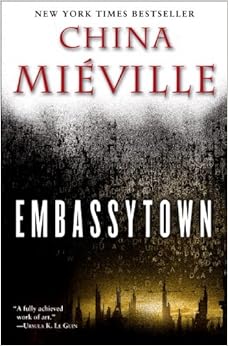
Book Review: Embassytown

A little preamble; this is my fourth China MiƩville book (King Rat, The City and the City, and Kraken), and with Embassytown, and a big part of what I love about each of these is how he plays with genre and concepts in his faction.

In Embassytown much of what we look at is alien and language. Considering how tricky human languages are here on Earth (for example, did you know that there is no term in French for cool (as in temperature?) - just take a second and think of how much that alters the average francophones world view in terms of temperature), imagine how tricky it would be for a language with absolutely no shared points of interest.

The novel follows a woman named Avice Benner Cho, a child raised on the world of Arieka in the city of Embassytown who grows up to become an "immer", someone able to travel through an area of space around the world called the immer. The world itself is shared with an alien species called the Ariekei (also referred to as The Hosts), who have a concept of language that take a while get your head around.

The novel follows some key events in the city throughout the life of Avice and focuses largely on how different cultures work to understand each other without many shared reference points - for example the aliens don't really view most humans as sentient.

Although this wasn't my first experience with SF focused on questions of language, it was definitely the most immersive one I've ever come across.

Monday, July 20, 2015

The Ophiuchi Hotline, by John Varley

One of the things I enjoy best about reading Speculative fiction is the fact that more often than other most other genres it leads to these great moments for me wherein I have to take another look at my own world and try to view it from another perspective.

John Varley's The Ophiuchi Hotline largely asks the question, "What makes me, me?" The main character, Lilo begins the book waiting for her own execution for genetically modifying human DNA, then she is offered a bizarre choice; a clone of her is brought in and offered to be killed in her place, if she agrees to take on certain work in secrecy for the government. Then the clone, coming to full awareness, states that it will happily do this job if the agent chooses her over the original...

The next chapter (2) begins with one of the Lilos killing herself before execution and the other beginning the new work, but specifically doesn't inform the reader who we are now following - over the course of the novel more than a few additional Lilos begin to pop up (sorry for the mild 38-year-old spoiler), and again and again the reader must decide which, if any, of these protagonists have more validity than the others.

The story travels throughout our solar system, involves aliens and alien invasions, but focuses largely on the morality of cloning and the question of identity.

A truly fascinating read.

Tuesday, April 14, 2015

Book Review: Woman on the Edge of Time

Having now hit the year of my birth (1976) in my copy of David Pringle's Science Fiction: The 100 Best Books published in English from 1945 to 1985, the stories are getting a little different for me; Although some of the concepts and technology still requires me to look them up, I'm getting to the point where I'm sharing the same (or at least a similar) frame of reference with the author and the target audience.

Marge Piercy's Woman on the Edge of Time is a little different from most of the science fiction I've come across, as much of the story can either be viewed as a tale of a telepath or the ravings of a crazy person.

The story, taking place in 1976, follows Consuela (Connie) Ramos, a 37-year-old woman who begins to book by being unjustly sentenced to a mental institution by her niece's boyfriend and also happens to be receiving telepathic transmissions, and visits, from a few hundred years in the future.

The book moves back and forth between Connie's psychic visits to a pretty Utopian future world (it's not perfect, but pretty close) and her attempts to escape or graduate from the institution she finds herself in (which is pretty similar to Ken Kessey's 1962 novel, One Flew Over the Cuckoo's Nest). 

A lot of what I really liked about the novel (which I viewed as actual visits from the future, btw), was how easy it would be to discount Connie's experiences and assume they are a fantastic world she has created for herself, but I found the book to be much more interesting if viewed as actual visits from and to the future.

A Fascinating Read!

Thursday, April 9, 2015

Turns out I may be more a Science Fiction Fan

So here's the thing - as a long-time fan of Fantasy, Horror and Science Fiction reading I have a sort of internal measurement in which I can say which genre has more sway on my reading habits at any given time.

I like to think of it as my "Zombie Robot Unicorn" meter.  Basically I liken my current reading habits to an internal image of a Zombie Robot Unicorn and use it to describe my current thoughts about whatever I'm reading.

In practice the image shifts to a much more "zombie-fied" robot unicorn in October and perhaps a bit more "Unicorn-ed" Zombie Robot during the winter.

Over the weekend however I went through my book award and top 100 lists I've been reading my way through over the last decade and realized that I'm actually steadily reading more Science Fiction than either of the other two and have been for some time...

I guess my Zombie Unicorn is much more robotic that I've previously though.

IMAGE CREDIT

Tuesday, February 24, 2015

Book Review: Orbitsville

Continuing through my survey of 1970s era Science Fiction, I've just finished Bob Shaw's 1975 novel Orbitsville, which I found to be both intriguing and a little alarming (but in a really good way).

The novel focus on ship captain Vance Garamond, who while waiting to meet the CEO of the most powerful company on Earth makes a rather (sorry for the mild forty-year-old spoiler of the events of the first chapter) terrible mistake and through a moment of negligence allows the CEOs only child to die in an accident.

Obviously the next segment of the book follows his rapid escape from Earth and his attempt to hide from the most powerful person in the world, which leads to Orbitsville itself, a massive Dyson sphere (wherein a hospitable atmosphere and environment exist across the inside of a globe) but the sphere itself is so massive it is almost beyond comprehension.

For classic SF readers, the book is clearly going to draw comparisons with Larry Niven's Ringworld (1970), but although there are a number of similarities between the two - world exploration, action and adventure, Orbitsville plays down the aliens aspect and focuses much more on the alien nature of the world itself.  

The book was a quick read, quite fascinating, and ended with a turn of events I was definitely not expecting.  Well worth a read.

Tuesday, December 16, 2014

Book Review: Galaxies, by Barry N. Malzberg

Having worked my way through 80% of David Pringle's Science Fiction: The 100 Best Novels, I've read a lot of different types of SF; from dystopian futures to time travel and space opera, but until yesterday I had never read anything quite like Barry N. Malzberg's 1975 novel, Galaxies.

The book (sorry for the mild 39-year-old spoiler) is stealth metafiction with a strong satirical bent, but you'd never guess this from the cover.  In fact, the cover image, of a spaceship flying into a skull, looks and reads exactly like a standard classic science fiction novel, still smelling faintly of the pulps, and probably published somewhere in the mid to late 1950s.

Once you open the book however, things go sideways very fast.  The novel moves between the writer talking about himself and his life to concepts of main story and back again, with quite a few musings on science fiction as a genre, it's readers and it's writers.

I absolutely loved this book - the story was fast paced, intriguing, and hard to forget, which honestly describes a lot of the fiction I love.

Well worth the read.