Showing posts with label Time Travel. Show all posts

Wednesday, March 6, 2019

Book Review: Hazards of Time Travel, by Joyce Carol Oates

So I picked up Joyce Carol Oates Hazards of Time Travel simply because I liked the title and I'd enjoyed her 1995 novel Zombie. The book starts in a dystopian future and follows a young woman named Adriane Strohl through her last few days of high school and her subsequent imprisonment in a University in 1959 Wisconsin.

On the surface, the book felt a lot like 12 Monkeys to me, wherein our protagonist is punished by being sent somewhere that is arguably better than where they came from. Are there problems? Absolutely, Oates has found a great way to highlight the negatives of late '50s America by showing it as a University based on blandness, everyone working hard to be consistently forgettable. Renamed Mary Ellen, Adriane stumbles through her first year learning and relearning exactly how closed off America was during the period and for me, some of the greatest strengths of the book come from the character study of Mary Ellen/Adriane, rather than the dystopian future or the science of the time travel.

An interesting read that left me with more questions than answers, but honestly, isn't that what we want from speculative fiction?

Thursday, August 9, 2018

Book Review: The Rise and Fall of D.O.D.O.

In Neal Stephenson and Nicole Galland's 2017 novel The Rise and Fall of D.O.D.O. mixes the speculative fiction concept of time-travel with government bureaucracy and although it was a touch long for my taste, it was, in the end, a fun examination of how bureaucracies can ruin pretty much everything.

The novel follows a Linguistics doctor named Melisande Stokes, who after having a particularly disastrous run in with her academic supervisor, runs into a mysterious government officer who offers her a job.

The majority of the novel is told from Melisande's point of view, and is written as a document she has deposited in a bank from Victoria England, where she has been trapped in the past.  Other characters and story elements get focus through internal memos, newspaper clippings, personal journals, etc.

The novel focuses on exactly how a government agency might go about setting itself up with a time-travel based department, and the increasingly byzantine obligations put on it as its importance raises over time.

Although it works strongest in concepts, rather than person to person interaction, in the end I found it to be quite a fun read.

Tuesday, March 7, 2017

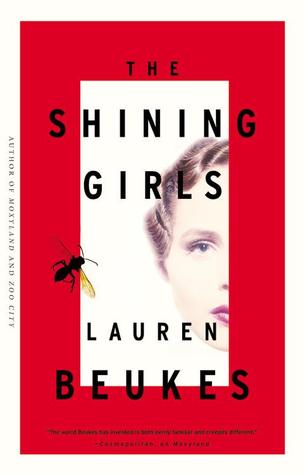
Book Review: The Shining Girls

Lauren Beukes 2013 novel The Shining Girls is a little tricky to peg down in terms of genre. The story works as a thriller, a time travel story, as well as a mystery, and showcases the city of Chicago over a sixty-year span.

To describe the book I'm going to have to get into the twists and turns a little, so sorry for the four-year-old spoiler, but if you want to read the book cold here is my short review.

A fast read, really intriguing, included large sections where I simply could not put the book down.

Back to the longer review; the story focuses on Harper Curtis, a drifter in depression-era Chicago who finds his way into a house that allows him to travel throughout sixty years of time, starting in 1931 when he finds the house and ending in 1993. Inside the house Harper finds trophies of the Shining Girls, women he has/will kill to continue to power the unique abilities of the house. The story involves Harper bouncing back and forward through time on his murder spree and equally focuses on one of the shining girls, Kirby Mazrachi, who survives her attack and then begins to work to track down this terrifying killer who she first saw as a child and next years later when he attempted to kill her.

As a character, I was pretty impressed with Kirby, you see her at three distinct ages in her life and I found I was really rooting for her as she attempts to make sense of the nonsensical.

A pretty great read and an author I'm definitely looking forward to following.

Sunday, December 11, 2016

Book Review: No Enemy But Time

As I near the end of making my way through David Pringle's Science Fiction: The 100 Best Books, I am increasingly glad for both the new finds and the authors I'm returning to again.

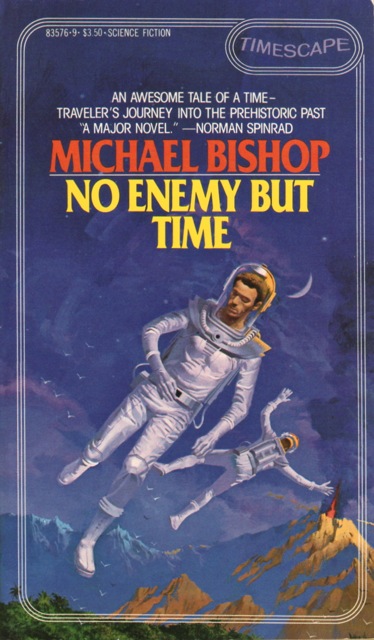
Case in point, last week I read Michael Bishop's 1982 Time Travel novel No Enemy But Time.  This was my third time reading a Bishop novel, but my first time reading his Science Fiction.  Previously I had read the horror novel Who Made Stevie Crye? and the Fantasy novel Brittle Innings and had really enjoyed both.

No Enemy But Time focuses on John Monegal, a chrononaut (Time Travelling explorer) who has been dreaming of the African Pleistocene era since birth, and with the help of an American agency begins the novel by travelling back in time to that specific era.

The novel moves back and forth between his study of the Homo Habilis people he finds in prehistoric Africa and his own life's journey that lead him to this point.

I found the novel fascinating throughout (but was a little confused as to why the cover image (seen above) depicts a white guy when the character is black), and enjoyed both John's journey from boy to man and his later journey with people who only see him as a strange creature.

As a man lost in time novel, it was a heck of a lot of fun, and leaves me interested in both finding more of Bishop's work, and of reading my next (and final) book on this crazy SF list I've been reading for nearly eight years now.

Thursday, July 28, 2016

Hitting my first science fiction novel of the 1980s on my list of David Pringle's Science Fiction: The 100 Best Books: An English Language Selection: 1949-1984 feels like a pretty big accomplishment. At this point I've read 94 of the 100 novels listed, and am really looking forward to completing this list.

Timescape (1980), by Gregory Benford follows two separate timelines, one beginning in 1998 and the other in 1962 and both follow scientists (two in an ecological disaster ridden United Kingdom in the later time frame and one a physicist in California in the earlier one). As modern attempts to stop a number of environmental blights have failed, a suggestion is made to send messages back in time using tachyons (faster than light particles) to the earlier time period and avoid the current mess altogether.

What I really enjoyed about this book was how, considering the book could definitely be considered Hard SF (focusing on technical or theoretical detail), an awful lot of the book focused on people and how they reacted to external stresses, all of the scientists families feature, and did a great job of showing just how hard it can be to live with someone so driven by their work.

The novel is pretty great, although not an action adventure like many of my favourite time travel stories, it works its way into your mind, making you ask questions about how time really works and how we perceive our pasts, presents and futures, which is actually a pretty good way to describe any great science fiction story.

Thursday, May 26, 2016

Book Review: Beauty

Put simply, Sheri S. Tepper’s 1991 novel Beauty, is an examination of a number of classic western fairy tales (both Grimm and Perrault stories are represented) which includes elements of Science Fiction and focuses strongly on issues of Environmentalism and women’s roles in the middle ages.

The story follows Beauty (of the Sleeping variety, rather than the one with the Beast), as she moves through a number of classic stories taking on (mild, 25-year-old spoiler) various roles in various fairy tales. The story also includes a trip to a dystopian future and journeys to the more fantastic realms of Faerie and Hell.

Although slow to start, I found I enjoyed the narrative more and more as Beauty began to stretch beyond her own story. In many ways the book reminded me of Ursula K. Leguin’s Lavinia, although as a huge fan of the Ancient World, I did enjoy that one a little more.

An interesting read I would be happy to add to my own collection.

Wednesday, April 22, 2015

Movie Review: Predestination

There's always a risk that when it comes to adapting a beloved story something is going to go wrong.

When that story happens to be one of the classics of a beloved genre, it gets even trickier...

So imagine my apprehension at seeing that a movie version of "the mother of all Time Travel stories" was about to be made into a major motion picture.

Robert Heinlein's 1959 short story All You Zombies, is, for many people, one of the classics of the genre, right up there with Clarke's The Nine Billion Names of God or Bradbury's A Sound of Thunder (also a must-read for time travel fans), All You Zombies stands pretty high on the must-read list of science fiction.

The film totally impressed me - working it's way through the labyrinth-like storyline and using simply unbelievable makeup and visual effects the story caught my attention, stayed true to the original, and even gave it a twist or two I wasn't expecting.

Totally worth a viewing.

Thursday, April 2, 2015

So I'm reading the Outlander series now...

A few years back for one of my book clubs I read Diana Gabaldon's 1991 novel Outlander (originally published as Cross Stitch) and was pretty impressed.  At the time I hadn't had a lot of experience with Romance novels (my tastes normally move more in the "Zombie, Spaceship, Wasteland" direction), but was really surprised at just how great this first novel was.

Flashing forward to last year, my wife (who has read the entire series to date) and I began watching the recent Ronald D. Moore television adaptation, and I admitted that I would have to check out this series and soon.

Or as my wife likes to say "If you can spend a whole month inflicting me with Twilight the least you can do is read something good once in a while..."

Point taken.

As I read horror, fantasy and science fiction works each month I've noticed that Fantasy tends to work best in series readings, so for the next year, give or take, I'll be checking out some time travelling historical romance fiction.

Image Credit 
Outlander Series image from
https://www.pinterest.com/explore/dragonfly-in-amber/

Monday, December 24, 2012

Movie Review: Safety Not Guaranteed

On Friday I finally got around to seeing the science fiction film Safety Not Guaranteed.  Based on an actual classified ad put in a magazine in 1997, the film follows three journalists who are tracking down the mysterious writer of an advertisement which claims the following:

Wanted: Somebody to go back in time with me.  This is not a joke.  P.O. Box 91 Ocean View, WA 99393.  You'll get paid after we get back.  Must bring your own weapons.  Safety not guaranteed.  I have only done this once before.

Tracking the writer (Mark Duplass) down to his home, one of the journalists, (Aubrey Plaza) poses as someone responding to the ad, which is the setup for the film, wherein she learns about his proposed plan to travel back in time (again), and balances between disbelief and a growing belief in what he may or may not be doing.

The movie was a lot of fun, and part of the enjoyment comes from the fact that you can watch it (mostly - no spoilers through) either viewing the writer as crazy or a legitimate traveller.  

A fun film.

Sunday, August 26, 2012

Book Review: The Year of the Quiet Sun


Time travel stories are some of my favourites in the Science Fiction genre; From Back to the Future to Star Trek IV: The Voyage Home (which in itself travels from 1985 to 1955 and then one year forward for the movie-goer travels from 2286 to 1986 which totals a 331 year trip (unless you count the bit at the end of Back to the Future where they travel with Doc back to the future)… but I digress), Bring the Jubilee to The Time Machine I’ve always enjoyed time travel stories in film, prose and games.

And last week I found a new time travel story (well, new to me, actually the book is 42-years-oldm, but still, it’s new to me) in the 1970 novel The Year of the Quiet Sun by Wilson Tucker.

The novel follows a demographer and biblical scholar named Brian Chaney who, after releasing a controversial translation of the Book of Revelation, is taking an enforced vacation from work and is promptly hired by an American government agency to take part in a time-travel experiment.

For those of you who don’t know (and that counted me before I read the book), demography is the study of demographics, being populations and sub-populations, and Chaney had released a document earlier in his career which suggested potential future trends in these statistics.

Chaney joins a small team of a naval office and an Air Force officer who, as a team are shown all of the possibilities for where time travel could possibly take them.  Then after making a decision they are overruled by the current administration and sent two years into the future to see if the current President of the United States will win his upcoming election.

Yes indeed, this is a time travel story stomped on by administrative requests.

Without going into too many spoilers, the book is definitely worth the read, it was nominated in the best novel category for both the 1971 Hugo and 1971 Nebula awards, and I found it to be a really plausible look at how time travel could go if it became a reality.