Showing posts with label Fantasy. Show all posts

Saturday, September 9, 2017

Book Review: Eyes Like Leaves

Charles de Lint's Eyes Like Leaves was a pretty fascinating read for me, sort of a "what could have been novel". Originally written as his fourth novel, the story falls nicely into the High Fantasy sub-genre (think Lord of the Rings), rather than the Urban Fantasy he's much more connected to these days. The author actually notes in the introduction that the advice he was given by an editor at the time was only to publish if he wanted to focus future works on High, rather than Urban, Fantasy.

The story works quite nicely as a traditional quest-style novel, following a bard, a wizard in training, and a young woman who all seem to be tied together through destiny to the strange creatures who have suddenly begun attacking people throughout the land.

De Lint shines best with characters and setting, and although he does a great job with this novel, I'm a much bigger fan of his urban fantasy stories. A fun read, but really for dedicated fans rather than new readers of the author.

Monday, September 12, 2016

Book Review: Godmother Night

So it's no secret here that I'm a pretty big follower of various lists when it comes to reading; even at the rate I read books some sort of filter is required for selection or I'd end up trying it alphabetically.

As one of my favourite types of lists are award winners (Hugo, World Fantasy, Stoker, etc.), many of these books are available at my local library, but every once in a while I'll have a title sitting on my to read list for years while I attempt to track down a copy.

Case in point: Rachel Pollack's Godmother Night (1996), which has been on my used-bookstore list for over a decade; I've looked for this book in Alberta, Nevada, Illinois, Massachusetts, and Pennsylvania, to no avail. Then last month I figured I'd try out my local library's Inter-Library Loan service and my book showed up a few weeks later (sorry for the anticlimactic anecdote).

Godmother Night asks the question (sorry for the mild twenty-year-old spoiler) of how well would the personification of death do as a Godparent. The story follows two young women, and later their daughter through their lives as Mother Night (their world's version of Death) becomes directly involved in a young girl's life.

The story works best as a grown-up fairy tale (and yes, there are some very grown-up scenes in the book), and works as a series of vignettes focusing on two generations of a family and their loves, lives and deaths. A really fascinating book and one I was glad to finally check out!

Friday, July 15, 2016

Book Review: Towing Jehovah

James Morrow’s 1994 book Towing Jehovah is a satirical fantasy dealing with the death of God, literally. The book focuses on Captain Anthony Van Horne, a disgraced ship's captain who was responsible for a notorious oil spill. Captain Horne is charged by the Archangel Raphael to take the body of God to its final resting place, a monumental task, as the cadaver is over two miles in length and needs to be shipped to the arctic to be laid the rest.

The novel is incredibly satirical, dealing with how the catholic church would deal with both certifiable proof of Gods literal existence, as well as his demise, and focuses on themes of free will, religious and environmental extremists and how the death of God could effect mankind.

I found the novel to be a lot of fun, but have to admit I think many people would find the concept (or some of it's effects) to be offensive. Well worth the read, and leads to many interesting questions.

Monday, May 16, 2016

Book Review: The Ivory and the Horn

Charles De Lint’s second collection of short fiction set in Newford felt much more interesting to my than Dreams Underfoot (which I also quite liked), with the first collection I was pretty enamoured of how he was building this fascinating city setting and how he would cross multiple characters over throughout stories, switching timelines, perspectives, etc., but with The Ivory and the Horn, although there is a lot of that too, the stories move into some pretty dark territory, and allow the reader to read about some deep real world issues (such as falling in love with a good friend, the effectiveness of social work, dealing with a friend’s depression), and uses fantasy elements to draw the reader in.

For me, stories like “Dead Man’s Shoes”, a vengeance-based ghost story worked great as effective horror, but others like “The Wishing Well” showed exactly how insidious a crisis can be and how easily people might ignore it. The collection moves easily from issues involving homelessness to urban fantasy (my favourite of the latter is “Mr. Truepenney’s Book Emporium and Gallery” which asks how responsible we are for our dreams.

A great collection, and definitely had me looking forward to reading my next de Lint book.

Monday, April 11, 2016

Book Review: Earthquake Weather

The third and final volume in Tim Powers Fault LInes series, following Last Call (1993) andExpiration Date (1995), Earthquake Weather follows the main characters of both previous novels as Scott Crane (mild 18-year-old spoiler) is killed by those who want his crown, and his only hope is that of Koot Hoomie, a twelve-year-old who years ago was possessed by the ghost of Thomas Edison.

As much as I loved Last Call and really liked Expiration Date, I found Earthquake Weather to be overloaded on main characters (often giving them very little to do), and more in love with the setting than the story. It does conclude the events of the previous two novels, but wasn't as strong as either of the first two books.

If you've already started the series it's well worth the read, but otherwise I would skip it for his time travel novel, The Anubis Gates, or the vastly superior Declare.

Thursday, April 2, 2015

So I'm reading the Outlander series now...

A few years back for one of my book clubs I read Diana Gabaldon's 1991 novel Outlander (originally published as Cross Stitch) and was pretty impressed.  At the time I hadn't had a lot of experience with Romance novels (my tastes normally move more in the "Zombie, Spaceship, Wasteland" direction), but was really surprised at just how great this first novel was.

Flashing forward to last year, my wife (who has read the entire series to date) and I began watching the recent Ronald D. Moore television adaptation, and I admitted that I would have to check out this series and soon.

Or as my wife likes to say "If you can spend a whole month inflicting me with Twilight the least you can do is read something good once in a while..."

Point taken.

As I read horror, fantasy and science fiction works each month I've noticed that Fantasy tends to work best in series readings, so for the next year, give or take, I'll be checking out some time travelling historical romance fiction.

Image Credit 
Outlander Series image from
https://www.pinterest.com/explore/dragonfly-in-amber/

Monday, March 16, 2015

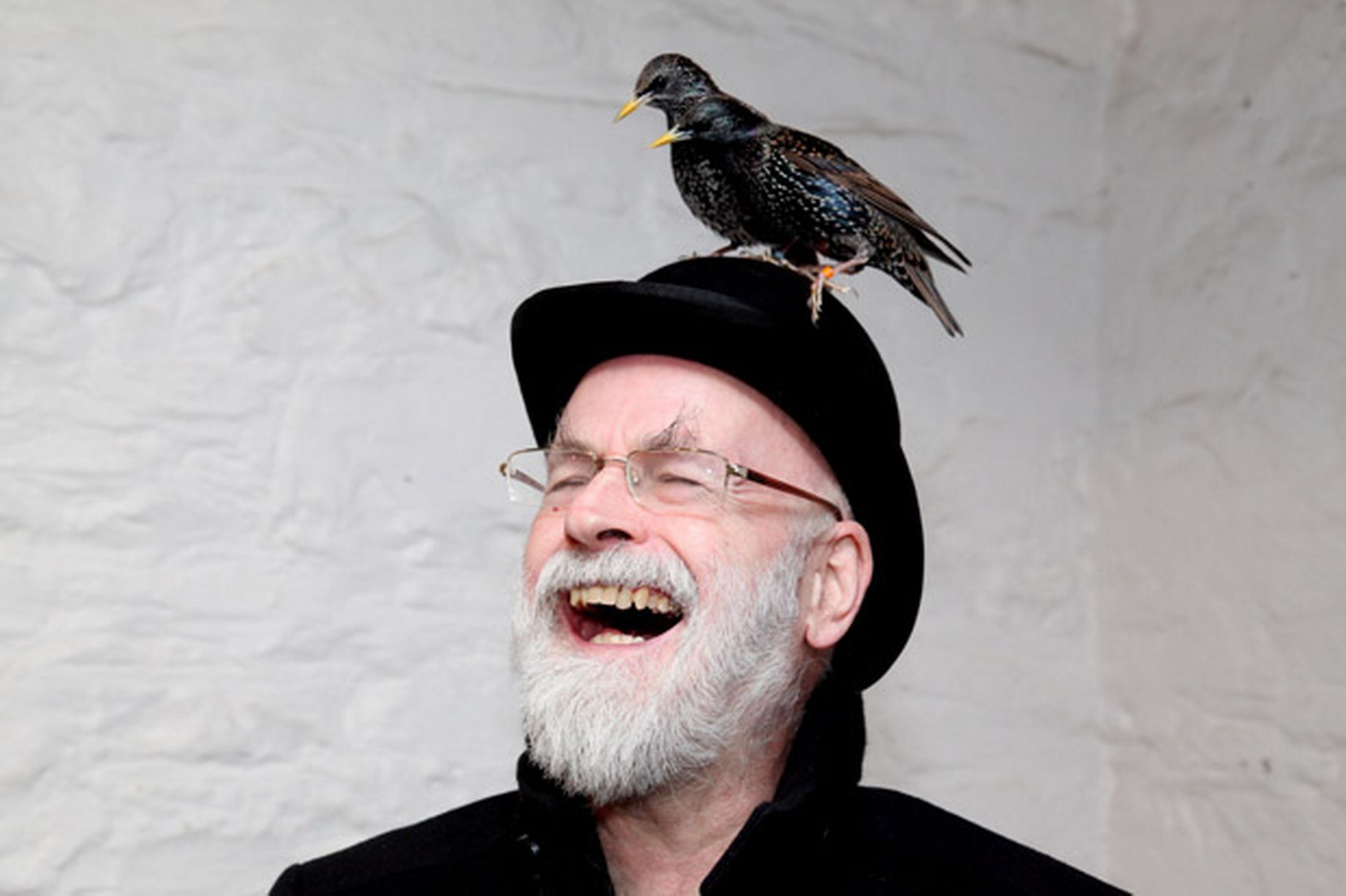
RIP Terry Pratchett

Although I’m a pretty voracious reader, I can only think of six authors who have inspired me to read through their entire bodies of work; Terry Pratchett was my fourth.

I found my way to his work through Good Omens, co-written by Neil Gaiman (being the third author I’ve taken that journey with in my life) and absolutely loved the humour and adventure of that book. Quickly finding many of my friends had read a Discworld novel here or there, I decided to go back to his first book, The Carpet People (written at 18) and after finding it a fun read (with an even better “about the author” section*) I decided to read a Pratchett book a month until I caught up with his current work.

This took me from June, 2005 to July, 2008 - afterwards I waited, like all his other fans for each new book to come out and take to me some pretty great places.

Each month I was more and more stunned by how he could build a world from something as simple as a parody of Larry Niven’s Ringworld into something that started talking to me about my world, my life as a friend, husband, parent, and reader.

At the moment I’ve got all of his books sitting on my shelves from The Carpet People to last years The Long Mars and I can honestly say they are some of my favourites in genre fiction I’ve ever come across.

Kirk "Bookmonkey" MacLeod


*a section which stated in many of his books that “…started work as a journalist in 1965 and saw his first corpse three hours later, work experience meaning something in those days”**


**have I mentioned how much I loved his use of footnotes?

Wednesday, February 11, 2015

Book Review: The Fair in Emain Macha

Moving from de Lint's workin the 80s into the 90s began with his entries for The Dungeon series, and then continued into The Fair in Emain Macha, which works as a spin-off of Arthurian legend.

The novella (the version I read included the Fritz Leiber story "Ill met in Lankhmar" on the flip side), follows Colom, the last member of an Irish tribe who has returned home after years of serving under King Arthur.  The story benefits from a basic understanding of the story of King Arthur, but doesn't require it, and is best described as mythic or epic fantasy adventure, with both a little romance and magic thrown in (Merlin is a supporting character).

At 104 pages the story moves along at an excellent pace, and give a intriguing look at de Lint's version of the Druid faith, as well as a dash of Viking mythology as well.

As I'm mostly familiar with de Lint through his Urban Fantasy stories, this was fun change and well worth the read.

Thursday, July 17, 2014

Book Review: Mulengro

My Charles de Lint book for June was actually a little bit of a departure from the first three; although I would still consider Mulengro: A Romany Tale a fantasy novel, it was much darker in tone than his previous books, almost moving in thriller territory in some scenes. The book follows a series of murders involving Gypsy (Romany) culture, and moves in and out of a look at the subculture itself and then the more magical aspects as well.

Like his previous book Moonheart, Mulengro has an ensemble of characters rather than one protagonist, and at this point I found all of the characters quite engaging and interesting. Adding to that the darker elements of the story and it could almost be considered dark fantasy (one of my favourite sub-genres of both Horror and Fantasy), so the book definitely worked for me.

Well worth the read, and I finally feel that I’m getting into the rhythm of his writing style, really glad I decided to give his works a try.

Saturday, May 31, 2014

Book Review: The Harp of the Grey Rose

Moving onto my third Charles de Lint novel, I've finally found one that I simply loved beginning to end.  The Harp of the Grey Rose (1985) follows a pretty straight forward fantasy fiction storyline; a young man meets a mysterious woman, sets out on a quest, and ends up having a significant destiny.

Even with that, however, the story moved along swiftly and like an excellent fairy tale, kept me either smiling at the great characterization or enthralled by the action sequences.  Having been a little underwhelmed by his first two books, but hanging on as my wife kept telling me that his later books would be right up my alley, I was happy to find this third book was pretty much bang on in terms of what I expect from quest-based fantasy fiction; swift, filled with great descriptions, and intriguing characters (my personal favourite, a bear who also serves as a harper himself).

A great read and strongly recommended.

Monday, March 17, 2014

Book Review: The Riddle of the Wren

The first novel by Charles de Lint, The Riddle of the Wren (1984) follows a teenaged girl, Minda Sealy, who begins the novel suffering from a series of terrifying nightmares and after the appearance of a strange man crying for help in one of her dreams, attempts to rescue him on an adventure that takes her to many strange worlds and places.

To me, the book felt liked it borrowed a lot from both The Hobbit(1937) and The Chronicles of Narnia (1949 – 1954), as the book has much of the structure of The Hobbit and the large talking animals from The Chronicles of Narnia (although I’m sure large talking animals have been around in fiction for a long time in lots of places). What actually surprised me was (sorry for the mild thirty-year-old spoiler) the world-travelling that Minda does throughout the book, wherein she uses henges travel between various worlds on her quest to stop the book’s villain, Ildran the Dream Master.

The book feels a lot like Young Adult (YA) fiction, and the world descriptions are really fantastic – my personal favourite, Darkruin, seems to be less a fantasy setting and more one in my favourite subgenre. The story, although fairly familiar to those who have read a lot of fantasy, involves a quest, terrifying armies and some magical items.

Well worth the read, and although I wish Minda was a little more developed as a character, it left me looking forward to my next book by the author, Moonheart: A Romance.
 

Friday, January 11, 2013

Things I've Noticed: There's this book called Game of Thrones


Right now I’m in the process of jumping on the bandwagon that is A Song of Ice and Fire – better known to the viewing public as Game of Thrones.  As I’ve said in the past, I believe that if I’m going ot go around and tell people I love the Fantasy genre, it is probably worth my while to explore the popular texts in the field because that it what I’ll get asked about by people on the bus, or in class, or at work.

So onto A Game of Thrones.

I was just starting High School when the first book in the series A Game of Thrones was released.  As High school kids don’t have a lot of cash it was probably in grade eleven when I started noticing a lot of my friends were reading the recently released paperback edition.  The cover (pictured right) showed a guy dressed in black sitting on a horse in a winter setting with a castle in the background and what appeared to be a fire burning some part of the building.  The cover looked exciting, my friends who were reading the book told me it was probably a hundred times better than the DragonLance stuff I was currently reading (probably due to the graphic sex and violence, we were teenaged boys after all), so I added it to my list of series I should get around to reading.

I picked up the book to read on Monday.

Now I’ll admit, after four sequels, a lot of awards and two seasons of an award winning HBO series, I’m probably coming to this pretty late, but at the very least I’m starting before the series is finished being written, which is something I usually never do, to avoid the curse of the Wheel of Time – a wretched state that has only released it’s hold on of my high school friends in the last few days.

Anyway, back to property damage (some mild 22-year-old spoilers follow), at one point early in the novel an assassination attempt is made using the burning of a castle’s library to draw attention away from the event.  Watching the library burn, the castle’s mistress Catelyn Stark, watched “…the smoke rise into the sky and thought sadly of all the books the Starks had gathered over the centuries.”  And you know what – I got pretty upset!  Even though this small library is purely fictional and even if it wasn’t it would not in anyway be available to me, I was still thinking: Come on!  Couldn’t you burn down some other part of the castle?  Why does it always have to be the library!

Then I realized I was getting pretty upset of the fictional destruction of a non-existent library collection and I realized two things.

1)     George R.R. Martin can really write – he totally sucked me in to the story.

And

2)     Any doubts that I’m in the wrong field of study have pretty much left the building.

So there you go – while reading a twenty-two year old fantasy novel I was able to reaffirm my career and professional goals – not bad at all.

Monday, December 31, 2012

Goodbye to 2012


Looking back over 2012 I had a lot of exciting things happen for me: 1) I’m now halfway through the process of getting my MLIS, 2) I saw a lot of great Fantasy, Horror and Science Fiction, and 3)My wife and I celebrated our 15th wedding anniversary, which means my marriage is now old enough to go to high school (I hope the popular marriages will let us sit with them!)

In classic genre works I discovered Zombi 2 and Shadow of the Colossus, and in terms of new stuff I loved there was Warm Bodies, The Cabin in the Woods, Chronicle, Safety Not Guaranteed, Old Man’s War, and The Hobbit.

The Third Season of The Walking Dead blew me away and both of my kids shocked me with how good they are getting at videogames, work, reading and life.

So Happy 2012 everyone, and let’s have an amazing 2013!

Monday, December 10, 2012

Movie Review: Snow White and the Huntsman

Last weekend I finally got around to seeing Snow White and the Huntsman, and you know what, I actually really liked it!  Considering this was the second recently released Snow White-themed film I've seen in the last few months, and that I was sort of tepid regarding Mirror Mirror, I honestly didn't go into the film with a lot of expectations, but in the end it's pretty great.

The film looks great - the cinematography, the costuming and the art direction were actually pretty amazing, while watching the film my oldest daughter commented that the movie looks an awful lot like my personal favourite anime film, Princess Mononoke - which it turns out it was - the writer actually states that Princess Mononoke was the main influence and inspiration for the film.

We got the movie from our local library, and for a cost of $0, it was a great way to spend an afternoon.  Seriously, a pretty cool movie.

Thursday, February 23, 2012

Things I've Noticed: Classics and Genre Fiction

*A quick note – When I say Classics and Genre Fiction I’m not talking Classics of Genre Fiction (Asimov, Matheson, Tolkein) but am instead talking about Classics (Homer, The Bible, Plato) and modern genre fiction.

For years I’ve had the feeling that I should be reading classics of literature, but where to start? There are tonnes of books which can be considered classics and honestly, in my life I am not going to have the time to read them all. A few years ago I received a gift from my BFF Mike and his lovely wife Trish which ended up being one of my favourite books ever.

How To Read a Book by Mortimer Adler (1972). The book itself focuses on how you can take a skill the literate world takes for granted, reading, and how to do it more effectively. It covers how to read histories, fiction, school texts, science and mathematics books and a whole lot more. In the back of the book he gives a reading list that starts at the beginning of Western Civilization and moves forward to the 1960s.

So my current plan is to move through his list (you can see it here) at one book a month. February’s book is The Iliad and so far I really love it. The story is nearly 3000 years old and involves magic, gods, and the kind of violence I haven’t seen since reading Richard Laymon’s The Cellar. I’m reading the book a chapter a day and honestly I’m really enjoying it. The fact that the story is referred to in over and over again throughout classic and modern literature is just a bonus. Next month for me is The Oddessy, and after that I’ll be checking out Aesop’s Fables.

It’s just kind of cool, at the beginning of this project that when I step away from Horror, Fantasy and Science Fiction to read some stuff that is “good for me” I’m met with a significant amount of Horror and Fantasy.

Friday, March 5, 2010

Things I've Noticed: Real World Benefits of Genre Reading

Over the last seven months I've written a lot about my love of Fantasy, Horror and Science Fiction, and due to the fact that I read a lot of the stuff, I will be going on about it for a long time. Today, however, I thought I would take a look at how my favourite genres actually benefit me in the real world.

Fantasy
If there is one thing in my life I can say the Fantasy genre has directly helped me in, it is a love of the outdoors. I've loved camping since I was a kid, when I could go on a hike and pretend I was Hansel, trying to find my way back home, or a knight of the round table searching for the Holy Grail. In my teen years it was more likely to be scenes from Dragonlance or Lord of the Rings that played in my mind while camping, and now as a parent, I can honestly camping has become one of my favourite activites, I like the quiet, the time with my wife and kids, and the view (seen above - Jasper, AB, Canada).
-Thanks Fantasy.

Horror
From a very early age, Horror helped define my as a boy. I was the only boy in a house of girls, so I naturally gravitated towards books that I felt were especially for boys (I don't think this any more, but come on, I was under 12 and looking for something I could call my own). In my mind, horror has lead the to the theory of breaking down any problem into its component parts and attempting to solve it - Horrible ghost steals your kid? Get a teeny tiny lady to help out - Horrible god from another dimension (pictured above) taking over your city and unleashing an army of ghosts? Get some friends together and take her down (but don't cross the streams). I've always enjoyed finding the solutions to problems, and the horror genre consistently shows me that even the most terrible things can be stopped - for now.
- Thanks Horror.

Science Fictiion
In my mind, one of the best real life uses for Science Fiction is its ability to prepare you for change. As virtually every story involves a cultural, scientific, or location change, a keen reader can pick up skills and strategies for change in their own life. The key aspect I've latched onto from my favourite characters in SF is the way they are always in a state of learning or exploration about their world - it's a big part of why I'm taking part time university courses in my world, helping me develop and grow - and also, if I want to become some sort of space-librarian (the view from my potential space-office, pictured above), I'm going to need more fancy initials after my name. In the end, the best SF is about exploration, and I think it has inspired me to explore my own life.
-Thanks Science Fiction.

There are tonnes of other real-world benefits from reading genre fiction (for example, preparing for a possible zombie apocalypse means doing a lot of cardio which is good for the heart, lungs, and whichever part of you the zombies would try to eat first), I've just listed the ones that most easily come to mind for me.

Friday, November 20, 2009

Things I've Noticed: I'm starting to by less new genre films on DVD

Looking over my DVD collection this morning, I realized that I'm not buying a lot of the new stuff in genre films lately. I mean sure, I've got The Lord of the Rings Extended Edition Trilogy boxed set, but that came out back in 2001, 2002, and 2003. If you only go back 5 years, to 2004, and you take into account that a number of DVD's I get are for my kids (Harry Potter and Narnia), my genre films on DVD are pretty slim.

I do love genre movies, and have seen lots of them in theatres, rented lots more and even waited for the public library to get some because they don't deserve my rental dollars (Transformers). But looking over my stuff, I've be surprised if I have more than ten genre flicks from the last 5 years.

Taking into account that I'm only talking about films, not Television series, here's what I've got.

In Fantasy since 2004, I own Pan's Labyrinth, Mirrormask, Lady in the Water, and Stardust, all of which I've watched on DVD at least twice, most of which I've checked out the special features on. When I think of spending money on Fantasy films, I just find that a lot of it ends up going to stuff that would be perfect Christmas or Birthday gifts for my daughters.

In SF since 2004, I own Children of Men and Sunshine. I know that you can consider most Super Hero flicks to be SF, but as I buy most of them for my kids, they aren't really my collection. To be fair, since my BFF Mike is a huge SF and Super Hero fan, I can borrow these titles from him so there isn't as much of a need for me to purchase these.

In Horror since 2004, I've got Shawn of the Dead, Planet Terror and Slither. I am a pretty big horror fan, but even taking into account the 2009 horror films I'd like to own (Drag Me To Hell and Zombieland), I'm just not finding a big need to re-watch a lot of newer horror movies.

When I think about a movie that I might like to own, I have three filters that make sure I don't end up broke (pictured right).

1) Do I have somethings I'd rather do with this $20 bill?
2) As much as I liked it in theatres, will I ever re-watch this film?
3) Would I be embarrased if someone saw this on my DVD shelf?

I still by a lot of DVDs, but these days more of them tend to be hard-to-find classics and hidden gems of genre films. I hope that means I'm getting more discerning in my selections, rather than just being picky.

Wednesday, November 4, 2009

Genre Character of the Week: Latro

Recently I took a university course in Ancient Greece, and as I've found that reading related materials helps my grades, I started checking out movies and books which focused on the time period. The best find (for Ancient Greece) by far was Gene Wolfe's Soldier series featuring my pick for genre character of the week, Latro.

These books (Starting with Latro of the Mist) take place right at the end of the defeat of the Persian Wars in 479 BC (The Film 300 shows the beginning of the war). Our main character, Latro, who fought for Xerxes, has suffered a serious head wound and now has two serious problems: One, he has lost the ability to retain short-term memories (very much like Leonard in the film Memento), and has to keep a record of his life on paper now or he forgets everything, Two: Latro can see the gods.

The Greeks actually have a pretty big history of people dealing with the gods in a regular, sort of day-to-day format (The Iliad has a lot of this), but I just love how Latro is able to notice the gods and be noticed by them while all the people around him are unaware. Through the series he ends up with a slave girl called Io, who is maybe 9 or 10 when they first meet, and who is very helpful to him in protecting him from people who might want to take advantage. As Latro (a name given to him by a surgeon as his own name is forgotten), travels through the ancient world, he meets more and more of the gods and does a lot of mini-quests, helping them in return for clues as to who he really is.

The thing I admire most about Latro is his innocence. Although he is a soldier, and a formidable one at that (he kills a lot of people throughout the series), his injury has knocked his preconceptions and judgements right out of his head. He takes everyone as they appear at first, regardless of whatever he is told by others and simply lets their own actions decide his opinions of them. I also love how the gods seem to be just as surprised that Latro can see them as the people around him.

The third book of the series, Soldier of Sidon, takes place in Egypt and is filled with Egyptian, rather than Greek gods, and as Latro has amnesia, readers can jump on in any of the three novels. My only complaint is that I want more! Latro is desperate to find out who he is and how to return home (wherever that is), and at this point in the series he is a little closer, but still not there yet.

Historical fiction usually needs a main character who is removed from the prejudices of the age or modern readers won't be able to relate as well. Latro, with his strange way of seeing the world, is a very unique solution to this issue, as he may have had all those prejudices once, but now must simply trust people on what he sees (and writes down.)