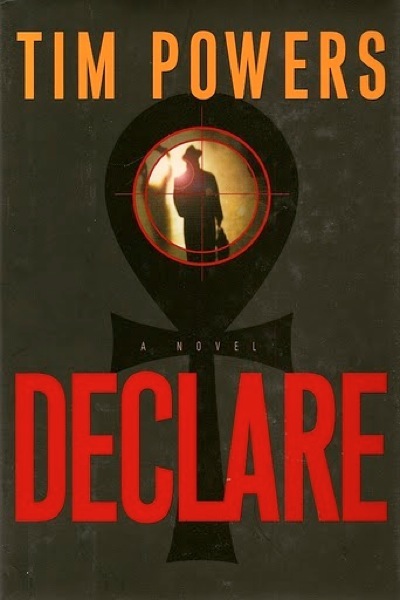
Reading my latest Tim Powers, Declare (2001), winner of the International Horror Guild Award and World Fantasy Awards for Best Novel, I'm finding it a little tricky to explain how much I enjoyed this book.
Focusing on spies in Britain and Russia during the Cold War, and taking place just after the second world war and in the early sixties, the book takes a number of real world events and people and weaves around them a story filled with dark magic and a pretty terrifying concept for the dominance of the USSR during the period.
Although Powers novels are filled with a large cast of characters, different timelines and convoluted plots, I found this book (which has all three of those aspects) moved at a really great pace and put me in mind of the spy fiction of John Le Carré.
The story works as most great spy novels do, with intrigue, sadness, and a large focus on past events and cause and effect. A really great book and one I'll definitely be looking to add to my shelves in future.
The third and final volume in Tim Powers Fault LInes series, following Last Call (1993) andExpiration Date (1995), Earthquake Weather follows the main characters of both previous novels as Scott Crane (mild 18-year-old spoiler) is killed by those who want his crown, and his only hope is that of Koot Hoomie, a twelve-year-old who years ago was possessed by the ghost of Thomas Edison.
As much as I loved Last Call and really liked Expiration Date, I found Earthquake Weather to be overloaded on main characters (often giving them very little to do), and more in love with the setting than the story. It does conclude the events of the previous two novels, but wasn't as strong as either of the first two books.
If you've already started the series it's well worth the read, but otherwise I would skip it for his time travel novel, The Anubis Gates, or the vastly superior Declare.
 The second in Tim Powers "Fault Lines" series, following Last Call, Expiration Date (1995), focuses on ghosts and the effect they have on those they leave behind. As with Last Call, the book follows a number of characters connected to the fantastic conceit of the novel (the devouring of ghosts by the living, rather than spells that can be cast using playing cards, which was the conceit behind Last Call), including a ten-year-old orphaned (sorry for the 21-year-old spoiler) in the first chapter, a burnt out therapist, an ex-assistant to an exorcist, and Thomas Edison.
The book looks at a number of original concepts, and as someone who reads a lot of urban fantasy, it's kind of nice to read a title that isn't dependent on a Vampire/Werewolf/Demon lover of a young girl, which seems to make up the bulk of the sub-genre. Powers does sometimes lose my attention as a number of his characters are very vocal about not wanting to be involved - which can be an interesting character aspect, but is easy to bleed into the reading experience if repeated enough in the book.
In the end I didn't quite like it as much as Last Call, but it was still a fun read nonetheless and I'm looking forward to reading the final work in the series, Earthquake Weather later this month.
Also - check out the new (thematically related) trailer for Ghostbusters!

Working my way through the best novel winners of the World Fantasy Awards (WFA), I've discovered a lot of pretty great authors and rediscovered a few I hadn't read in a while. Tim Powers, for instance, wrote both a great fantasy novel I read years ago called The Drawing of the Dark (1979) and The Anubis Gates (1983) a pretty amazing time travel story as well.
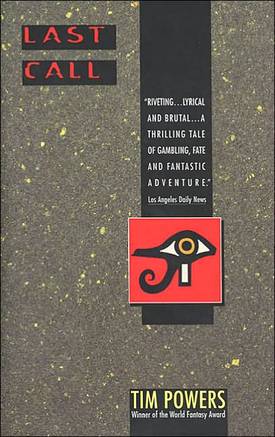
So I was happy to return to this list after a few years and check out his 1993 WFA winner for best novel, Last Call.
The novel mixes card games and magic in a similar way to Fritz Leiber's Conjure Wife (1953), only in that one it was magic mixed with the academic world of Post Secondary Instructors and their spouses.
The book focuses on Scott Crane, a man with a complicated past, the origins of the city of Las Vegas and a magic system strongly tied in with games of chance and Tarot cards. Part of what I've loved about all of Power's books I've read is the fact that his fantastic elements seem to have so much work behind them; not only is the magic in Last Call well defined, but different characters understand it to different degrees and find it works (or doesn't work) in varied ways depending on what they are doing.
The story also ties in with the legend of The Fisher King, includes ghosts, questions of destiny, and family relationships. Although it did take me almost a week to read, I found the book to be quite engrossing and plan to check out the sequel Expiration Date (1995) later this month.