Showing posts with label The Long Earth. Show all posts

Saturday, November 21, 2015

Book Review: The Long Utopia

Terry Pratchett and Stephen Baxter's Long Earth has been quite a treat for me since The Long Earth was published back in 2012. Taking place on an Earth where citizens can "step" into parallel Earths, (basically the same as ours, excepting the fact that human's don't appear to naturally exist on any other Earth discovered so far), the series looks at how, over the course of decades, society would deal with the sudden appearance of effectively unlimited resources and land, simply a step away from everyone.

This book, the fourth of a projected five, was a little melancholy for me, as co-author Terry Pratchett passed away earlier this year, it's hard to read the book without realizing that you are coming down to the last few novels from this writer.

The Long Utopia continues the story from the third book in the series The Long Mars, but in this one an interesting twist is added. New creatures begin to appear in a parallel earth, but unlike humans who've got there by either stepping "east" or "west", these creatures have stepped in from somewhere else altogether, kind of like the sphere who tries to explain his three-dimensional world to a square in Edwin Abbott's Flatland.

Following along with the conceit from the previous novels, all of the main characters are now in their later fifties and early sixties, which definitely adds to the one dimension not benefited by the introduction of the Long Earth, time. No matter how much exploration the characters have been able to do across millions of parallel Earths in the series to date, they are all getting older and their stories will be ending soon.

A good read.

Saturday, August 9, 2014

Book Review: The Long Mars

This week I read the final novel in Terry Pratchett and Stephen Baxter's Long Earth sequence, The Long Mars.

As with the previous two books in the series, The Long Mars focuses on a near future world where technology has allowed mankind to "step" from our world to parallel Earths, only unlike in most parallel Earth fiction, these new worlds are largely unpopulated.

What I've loved about the series is how it plays with exactly how this sort of dramatic increase in resource would effect our world - if you move dozen (or even millions) of parallel Earths away from home and create your own town, why would you owe taxes to your home country?  If you can travel millions of worlds away, what could be billions of worlds away?

In The Long Earth, one of those worlds is simply called "the gap" in that version of Earth there actually isn't any Earth at all, simply a void where our planet should be - so certain scientists begin the process of building space stations there.  One of the real challenges of  space exploration is escaping Earth's gravity, so the ability to simply step into a space where the Earth isn't dramatically changes the resources required to explore our solar system.

In the end I loved this book, it was a lot of fun, and does feel like the end of a sequence, it plays around in both space and time (one of the story lines covers more than a decade while the others are limited to a few months) my only mild complaint about the book is that on page 287 there is a spoiler for Kim Stanley Robinson's Red Mars - although to be fair, that book was published 19 years ago, so part of the blame may lie with me.

Thursday, February 13, 2014

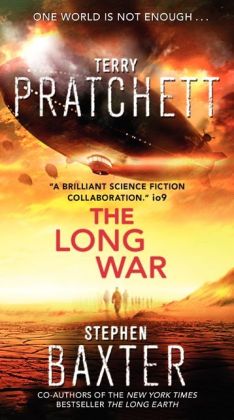
Book Review: The Long War

Yesterday I finished The Long War, Terry Pratchett and Stephen Baxter's follow-up to their 2012 novel The Long Earth.  The book takes place ten years after the discovery of The Long Earth, a series of parralel Earths accessible to most everyone on Earth; also when I say a series, I mean millions.

The book itself focuses on how governments across the world deal with a massive shift, being the exodus of their citizens into parallel versions of their own countries sometimes millions of worlds away.  Are these people still citizens?  Do they still pay taxes and require government services?

The book continues to follow the main characters from The Long Earth, and has both multiple story lines and in some of those story lines a quest format, but for me the most exciting bit was the sheer world building that goes on in the series.

The authors have already signed on for more books in the series, and if your interested in a great introductory novel to science fiction, the series is definitely worth a try.

Sunday, September 16, 2012

Book Review: The Long Earth


One of my favourite experiences in finding a new writer is when I’ve finally caught up with their published works and can start waiting for the new ones along with all their other fans.  For the past few years Terry Pratchett has been one of those I look forward to the most.  I read his discworld series and every other published book I of his I could get my hands on from 2004 – 2010 at the rate of one book a month and loved every one of them.
 
Last week I got a hold of his newest novel (co-authored with Stephen Baxter) The Long Earth, which I would describe as a science fiction novel taking place in a multiverse that borrows heavily from Larry Niven’s Ringworld and from Clifford D. Simaks Ring Around the Sun.
 
The story takes place on an alternate Earth where one day the plans for a dimensional hopper are transmitted around the globe through the Internet and soon the vast majority of Earth’s population begin travelling up and down (or, East and West as described in the book) many multiple Earths.  There is one strange thing however.
 
People don’t seem to exist in any of these Earths except our own.
 
The main character of the book is a young man named Joshua Valienté who is a particularly gifted “Stepper”, being someone who can step from world to world without the need for the gizmo virtually everyone else has to use.  Like Ringworld, the novel is very much a story of exploration, and although I did miss the standard footnotes which can sometimes be some of my favourite bits of any Pratchett novel, I did find the book to be fun, intriguing, and definitely worth the read.