Earlier this week I was able to catch an advanced screening to the new film Jason Bourne with my friend Ron, (who, as a proper fan of the series re-watched each of the earlier films in the franchise in the weeks leading up to this film).
The film, which comes nine years after The Bourne Ultimatum and twelve years after The Bourne Identity, picks up with Jason (Matt Damon) in Greece in hiding from the nefarious folks at the CIA, and due to actions beyond his control, ends up on the run again.
As the latest in what is clearly becoming America's answer to the Bond franchise, Jason Bourne delivers everything the ads have promised, action, mystery and Jason outwitting a room full of agents with all the resources in the world attempting to track him down.
I had a lot of fun with the film, but have to admit, in many ways this did feel like the latest instalment in a franchise - all the beats are hit, but it didn't feel quite as much of a game changer as Bourne Supremacy or Ultimatum. In the end, I had a lot of fun, and was happy to have seen it in theatres, but was left wondering where the next film will go.

Hitting my first science fiction novel of the 1980s on my list of David Pringle's Science Fiction: The 100 Best Books: An English Language Selection: 1949-1984 feels like a pretty big accomplishment. At this point I've read 94 of the 100 novels listed, and am really looking forward to completing this list.
Timescape (1980), by Gregory Benford follows two separate timelines, one beginning in 1998 and the other in 1962 and both follow scientists (two in an ecological disaster ridden United Kingdom in the later time frame and one a physicist in California in the earlier one). As modern attempts to stop a number of environmental blights have failed, a suggestion is made to send messages back in time using tachyons (faster than light particles) to the earlier time period and avoid the current mess altogether.
What I really enjoyed about this book was how, considering the book could definitely be considered Hard SF (focusing on technical or theoretical detail), an awful lot of the book focused on people and how they reacted to external stresses, all of the scientists families feature, and did a great job of showing just how hard it can be to live with someone so driven by their work.
The novel is pretty great, although not an action adventure like many of my favourite time travel stories, it works its way into your mind, making you ask questions about how time really works and how we perceive our pasts, presents and futures, which is actually a pretty good way to describe any great science fiction story.

Continuing my way through historical novels set in Ancient Greece, I've now left the Bronze Age and am now reading novels focusing on great figures of Classical literature, this month focusing on Sappho of Lesbos, considered one of the nine great lyric poets of the ancient world.
Although today most of her work is lost, with what little there is surviving in pieces, Peter Green has done a fairly fascinating job with his novel, in that her work is represented as thoughts and descriptions she makes throughout.
The Laughter of Aphrodite is narrated by the poet herself at about age fifty, looking back over her life and describing her childhood on the isle of Lesbos followed by her exile to Sicily and involvement in relationships, marriage, and motherhood.
At this point I've now read seven of these novels and am finding my knowledge of the Ancient Greek world is not nearly as good as I thought it was - the stories are still quite compelling, but as compared to Mary Renault's novels about Theseus, wherein I knew most of the story beats going in, I'm finding that the more based in history these novels get, the more I'm left focusing on the characters.
Peter Green has done a masterful job with a historical figure I knew virtually nothing about - I can't argue against any potential inaccuracies, but as far as compelling storytelling goes, he definitely drew me into the work and has me interested in reading more.
Last night I took my BFF Mike out to see the latest film in the Star Trek franchise, Star Trek Beyond. We saw the movie as part of a marathon, Star Trek (2009), Star Trek Into Darkness, and the newest instalment back to back, in IMAX.
First of all - IMAX is pretty much the best way to watch epic Science Fiction, the images move beyond enthralling and simply become immersive (also my inner thirteen-year-old was reawakened as the giant-sized screen works to make me feel smaller, like a kid again).
In the latest film (written by Simon Pegg and Doug Jung, and directed by Justin Lin) , the series moves beyond the original films and heads into new territory.
The film is a lot of fun, filled with high levels of action and a seriously strange new world, and although it is a sort of bitter-sweet experience, due to the recent passing of actor Anton Yelchin (who plays Checkov), I had a pretty great time. From my point of view it was a vast improvement on Star Trek Into Darkness and it brought back a crucial element to my science fiction adventure film experience...
It was a lot of fun!

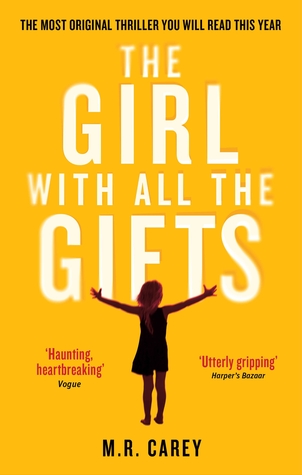
I actually came across The Girl with All the Gifts not because I'm a fan of the author (Mike Carey's The Unwritten being one of my favourite comic series), and not because the trailer for the film adaption just came out (starring Glen Close - HOLY CATS!), and no, not even because I spent a year reading largely only zombie-themed post-apocalyptic fiction, but instead because my wife read it and thought it would be my thing.
The Girl with All the Gifts is an incredibly well written in-depth character look at a small military base existing in the UK after an (mild spoiler) Extinction Level Event involving zombies. The novel focuses on a ten year-old girl named Melanie and that's just about all I want to say about it, plot wise.
Having read a LOT of zombie fiction over my life, what I really love about this book is the different way it went in concept and just how much it made me care about (or at least relate to) all of it's characters.
Totally worth the read, even if Horror books are not really your thing, and yes, this book will absolutely find it's way onto my shelves at home soon.
James Morrow’s 1994 book Towing Jehovah is a satirical fantasy dealing with the death of God, literally. The book focuses on Captain Anthony Van Horne, a disgraced ship's captain who was responsible for a notorious oil spill. Captain Horne is charged by the Archangel Raphael to take the body of God to its final resting place, a monumental task, as the cadaver is over two miles in length and needs to be shipped to the arctic to be laid the rest.
The novel is incredibly satirical, dealing with how the catholic church would deal with both certifiable proof of Gods literal existence, as well as his demise, and focuses on themes of free will, religious and environmental extremists and how the death of God could effect mankind.
I found the novel to be a lot of fun, but have to admit I think many people would find the concept (or some of it's effects) to be offensive. Well worth the read, and leads to many interesting questions.
Currently celebrating my oldest daughter Lorisia's 24th birthday with a delicious homemade chocolate cake (you can tell it's delicious by the look on her face and the fact that it was made by my wife... if I had made it the look would be cautiously optimistic)
Today was a pretty great day, celebrating a pretty great kid (sorry, young lady).
HAPPY BIRTHDAY LORISIA!